Subject does not meet the WP:N.(proposed by Let'srun )
If you can address this concern by improving, copyediting, sourcing, renaming, or merging the page, please edit this page and do so. You may remove this message if you improve the article or otherwise object to deletion for any reason. Although not required, you are encouraged to explain why you object to the deletion, either in your edit summary or on the talk page. If this template is removed, do not replace it.
The article may be deleted if this message remains in place for seven days, i.e., after 16:37, 26 June 2024 (UTC).
The Fairfield Community Connection (FCC) was a bulletin board system (BBS) located in Fairfield, Connecticut, United States. It was created in 1994 by SysOp R. Scott Perry. It was the largest BBS in southwestern Connecticut, consisting of over 8 nodes.
History
FCC was opened to the public on February 1, 1994, with four nodes, increased eight 8 nodes in May 1994, and finally to 14 nodes in February, 1996. It provided Internet e-mail starting in February 1994 and full Internet access in March 1995. It was merged with the Powerhouse BBS in June, 1996. The phone number was 335-4073.[citation needed]
FCC was set up using Galacticomm's Major BBS/Worldgroup software. Lacking in game and download sections, FCC's main appeal was its chat room(s). Many people also used the message boards to communicate. This local connection provided opportunities for BBS meets as well as long-term friendship with others.[citation needed]
FCC helped to usher in a larger era of BBS in southwestern Connecticut,[citation needed] including No Class BBS, Powerhouse, Kirby, Alcatraz and The Dog Pound.
FCC regulars included Snoop, Gambit, Montyp, Star, Raven and Master Wu.[citation needed]
A bulletin board system (BBS), also called a computer bulletin board service (CBBS), was a computer server running software that allowed users to connect to the system using a terminal program. Once logged in, the user can perform functions such as uploading and downloading software and data, reading news and bulletins, and exchanging messages with other users through public message boards and sometimes via direct chatting. In the early 1980s, message networks such as FidoNet were developed to provide services such as NetMail, which is similar to internet-based email.
FidoNet is a worldwide computer network that is used for communication between bulletin board systems (BBSes). It uses a store-and-forward system to exchange private (email) and public (forum) messages between the BBSes in the network, as well as other files and protocols in some cases.
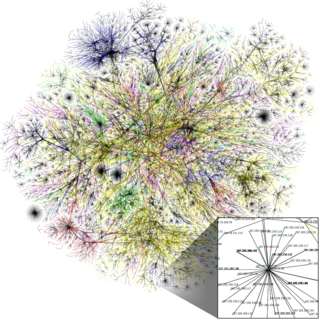
The history of the Internet has its origin in the efforts of scientists and engineers to build and interconnect computer networks. The Internet Protocol Suite, the set of rules used to communicate between networks and devices on the Internet, arose from research and development in the United States and involved international collaboration, particularly with researchers in the United Kingdom and France.
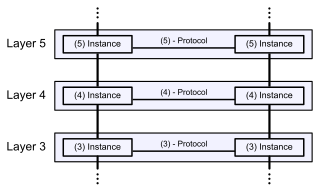
The Open Systems Interconnection (OSI) model is a reference model from the International Organization for Standardization (ISO) that "provides a common basis for the coordination of standards development for the purpose of systems interconnection." In the OSI reference model, the communications between systems are split into seven different abstraction layers: Physical, Data Link, Network, Transport, Session, Presentation, and Application. The names of these layers can be committed to memory via the following acronym: Please Do Not Throw Sausage Pizza Away.
The National Science Foundation Network (NSFNET) was a program of coordinated, evolving projects sponsored by the National Science Foundation (NSF) from 1985 to 1995 to promote advanced research and education networking in the United States. The program created several nationwide backbone computer networks in support of these initiatives. Initially created to link researchers to the NSF-funded supercomputing centers, through further public funding and private industry partnerships it developed into a major part of the Internet backbone.
In telecommunications, broadband or high speed is the wide-bandwidth data transmission that exploits signals at a wide spread of frequencies or several different simultaneous frequencies, and is used in fast Internet access. The transmission medium can be coaxial cable, optical fiber, wireless Internet (radio), twisted pair cable, or satellite.
UUCP is a suite of computer programs and protocols allowing remote execution of commands and transfer of files, email and netnews between computers.
Synchronet is a multiplatform BBS software package, with current ports for Microsoft Windows, Linux, and BSD variants. Past versions also ran on MS-DOS and OS/2, but support for those platforms were dropped in version 3.0.
WWIV was a popular brand of bulletin board system software from the late 1980s through the mid-1990s. The modifiable source code allowed a sysop to customize the main BBS program for their particular needs and aesthetics. WWIV also allowed tens of thousands of BBSes to link together, forming a worldwide proprietary computer network, the WWIVnet, similar to FidoNet.
A naked DSL, also known as standalone or dry loop DSL, is a digital subscriber line (DSL) without a PSTN service — or the associated dial tone. In other words, only a standalone DSL Internet service is provided on the local loop.
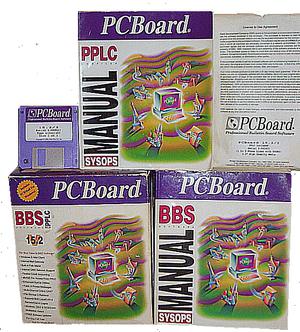
PCBoard (PCB) was a bulletin board system (BBS) application first introduced for DOS in 1983 by Clark Development Company. Clark Development was founded by Fred Clark. PCBoard was one of the first commercial BBS packages for DOS systems, and was considered one of the "high end" packages during the rapid expansion of BBS systems in the early 1990s. Like many BBS companies, the rise of the Internet starting around 1994 led to serious downturns in fortunes, and Clark Development went bankrupt in 1997. Most PCB sales were of two-line licenses; additional line licenses were also available.
The Major BBS was bulletin board software developed between 1986 and 1999 by Galacticomm. In 1995 it was renamed Worldgroup Server and bundled with a user client interface program named Worldgroup Manager for Microsoft Windows. Originally DOS-based, two of the versions were also available as a Unix-based edition, and the last versions were also available for Windows NT-based servers.
WTNH is a television station licensed to New Haven, Connecticut, United States, serving the Hartford–New Haven market as an affiliate of ABC. It is owned by Nexstar Media Group alongside MyNetworkTV affiliate WCTX, also licensed to New Haven. WTNH and WCTX share studios on Elm Street in downtown New Haven; per a channel sharing agreement, the two stations transmit using WTNH's spectrum from a tower in Hamden, Connecticut.
The monopoly position of the Bell System in the U.S. was ended on January 8, 1982, by a consent decree providing that AT&T Corporation would, as had been initially proposed by AT&T, relinquish control of the Bell Operating Companies, which had provided local telephone service in the United States. AT&T would continue to be a provider of long-distance service, while the now-independent Regional Bell Operating Companies (RBOCs), nicknamed the "Baby Bells", would provide local service, and would no longer be directly supplied with equipment from AT&T subsidiary Western Electric.
ExecPC is an online service provider started in 1983 by owner Bob Mahoney as the Exec-PC BBS. It quickly grew to be one of the world's largest bulletin board systems in the 1980s and throughout the 1990s, competing with the likes of Compuserve and Prodigy.
Excalibur BBS was a Windows-based GUI BBS software developed by Excalibur Communications. it was released in 1993, but it has not been supported since 1999 when Excalibur Communications ceased operations.
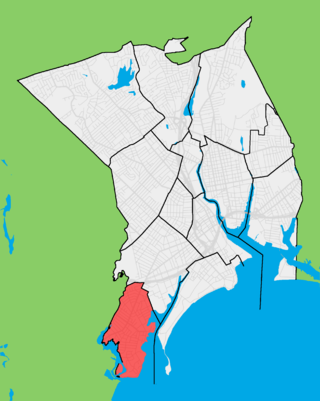
Black Rock is a neighborhood in the southwestern section of the city of Bridgeport, Connecticut. It borders Fairfield and the Ash Creek tidal estuary on the west, the West Side/West End of Bridgeport on the north and east, and Black Rock Harbor and Long Island Sound on the south. Black Rock comprises census tracts 701 and 702 and part of census tract 703. It includes two historic districts listed on the National Register of Historic Places. Residences comprise 86% of properties in Black Rock, 10% are commercial, and 4% are industrial or other property classes.
Internet in the Philippines first became available on March 29, 1994, 10:18 a.m., with the Philippine Network Foundation (PHNet) connecting the country and its people to Sprint in the United States via a 64 kbit/s link. As of February 2023, there are 85.16 million internet users in the country, where internet penetration stood at 73.1% of the total population.
Connecticut Public Radio, commonly known as WNPR, is a network of public radio stations in the state of Connecticut, western Massachusetts, and eastern Long Island, affiliated with NPR. It is owned by Connecticut Public Broadcasting Network, which also owns Connecticut Public Television (CPTV).
Digital Ocean, Inc., was founded in 1992 by Jeffery Alhom. Digital Ocean was a maker of wireless products from 1992 until it was disbanded in 1998.
This page is based on this Wikipedia article Text is available under the CC BY-SA 4.0 license; additional terms may apply. Images, videos and audio are available under their respective licenses.