Calcium fluoride

Last updated
Calcium fluoride
Calcium fluoride.jpg
Fluorite-unit-cell-3D-ionic.png
Fluorid vapenaty.PNG
Identifiers
3D model (JSmol)
ChEBI
ChemSpider
ECHA InfoCard 100.029.262 OOjs UI icon edit-ltr-progressive.svg
EC Number
  • 232-188-7
PubChem CID
RTECS number
  • EW1760000
UNII
  • InChI=1S/Ca.2FH/h;2*1H/q+2;;/p-2 Yes check.svgY
    Key: WUKWITHWXAAZEY-UHFFFAOYSA-L Yes check.svgY
  • InChI=1/Ca.2FH/h;2*1H/q+2;;/p-2
    Key: WUKWITHWXAAZEY-NUQVWONBAZ
  • [Ca+2].[F-].[F-]
  • F[Ca]F
Properties
CaF2
Molar mass 78.075 g·mol−1
AppearanceWhite crystalline solid (single crystals are transparent)
Density 3.18 g/cm3
Melting point 1,418 °C (2,584 °F; 1,691 K)
Boiling point 2,533 °C (4,591 °F; 2,806 K)
0.015 g/L (18 °C)
0.016 g/L (20 °C)
3.9 × 10⁻¹¹ [1]
Solubility insoluble in acetone
slightly soluble in acid
−28.0·10−6 cm3/mol
1.4338
Structure
cubic crystal system, cF12 [2]
Fm3m, #225
a = 5.451 Å, b = 5.451 Å, c = 5.451 Å
α = 90°, β = 90°, γ = 90°
Ca, 8, cubic
F, 4, tetrahedral
Hazards
Occupational safety and health (OHS/OSH):
Main hazards
Reacts with concentrated sulfuric acid to produce hydrofluoric acid
NFPA 704 (fire diamond)
NFPA 704.svgHealth 0: Exposure under fire conditions would offer no hazard beyond that of ordinary combustible material. E.g. sodium chlorideFlammability 0: Will not burn. E.g. waterInstability 0: Normally stable, even under fire exposure conditions, and is not reactive with water. E.g. liquid nitrogenSpecial hazards (white): no code
0
0
0
Flash point Non-flammable
Lethal dose or concentration (LD, LC):
>5000 mg/kg (oral, guinea pig)
4250 mg/kg (oral, rat) [3]
Safety data sheet (SDS) ICSC 1323
Related compounds
Other anions
Calcium chloride
Calcium bromide
Calcium iodide
Other cations
Beryllium fluoride
Magnesium fluoride
Strontium fluoride
Barium fluoride
Except where otherwise noted, data are given for materials in their standard state (at 25 °C [77 °F], 100 kPa).
Yes check.svgY  verify  (what is  Yes check.svgYX mark.svgN ?)

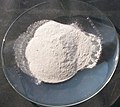
Calcium fluoride is the inorganic compound of the elements calcium and fluorine with the formula CaF2. It is a white solid that is practically insoluble in water. It occurs as the mineral fluorite (also called fluorspar), which is often deeply coloured owing to impurities.

Contents

Chemical structure

The compound crystallizes in a cubic motif called the fluorite structure.

Unit cell of CaF2, known as fluorite structure, from two equivalent perspectives. The second origin is often used when visualising point defects centred on the cation. Xtals combined 2 300ppi.png
Unit cell of CaF2, known as fluorite structure, from two equivalent perspectives. The second origin is often used when visualising point defects centred on the cation.

Ca2+ centres are eight-coordinate, being centred in a cube of eight F centres. Each F centre is coordinated to four Ca2+ centres in the shape of a tetrahedron. [5] Although perfectly packed crystalline samples are colorless, the mineral is often deeply colored due to the presence of F-centers. The same crystal structure is found in numerous ionic compounds with formula AB2, such as CeO2, cubic ZrO2, UO2, ThO2, and PuO2. In the corresponding anti-structure, called the antifluorite structure, anions and cations are swapped, such as Be2C.

Gas phase

The gas phase is noteworthy for failing the predictions of VSEPR theory; the CaF2 molecule is not linear like MgF2, but bent with a bond angle of approximately 145°; the strontium and barium dihalides also have a bent geometry. [6] It has been proposed that this is due to the fluoride ligands interacting with the electron core [7] [8] or the d-subshell [9] of the calcium atom.

Preparation

Naturally occurring mineral fluorite(CaF2)is the principal source of hydrogen fluoride, a commodity chemical used to produce a wide range of materials. Calcium fluoride in the fluorite state is of significant commercial importance as a fluoride source. [10] Hydrogen fluoride is liberated from the mineral by the action of concentrated sulfuric acid: [11] [12]

CaF2 + H2SO4CaSO4(solid) + 2 HF

High purity CaF2 is produced from the HF in the above reaction by treating calcium carbonate with hydrofluoric acid: [13]

CaCO3 + 2 HF → CaF2 + CO2 + H2O

Waste Product

Separately, calcium fluoride can be generated as a waste product via ion exchange of PFAS rich water using a durable layered double hydroxide(LDH) membrane of copper and aluminum heated to 500C. [14] [15]

Commercial Uses of Calcium Fluoride

Optical Applications

Lenses and Windows: Calcium fluoride is transparent over a broad range from ultraviolet (UV) to infrared (IR) frequencies. Its low refractive index reduces the need for anti-reflection coatings. Its insolubility in water is convenient as well.[ citation needed ] It also allows much smaller wavelengths to pass through.[ citation needed ] Calcium fluoride is used to manufacture optical components such as windows and lenses used in:

Metallurgical Applications

Chemical Industry

  1. Feedstock for the creation of fluorochemical refrigerants [16]

Glass and Ceramics

Dental and Health Products

Medical Applications

Other Applications

Safety

CaF2 is classified as "not dangerous", although reacting it with sulfuric acid produces hydrofluoric acid, which is highly corrosive and toxic. With regards to inhalation, the NIOSH-recommended concentration of fluorine-containing dusts is 2.5 mg/m3 in air. [13]

See also

References

  1. Pradyot Patnaik. Handbook of Inorganic Chemicals. McGraw-Hill, 2002, ISBN   0-07-049439-8.
  2. X-ray Diffraction Investigations of CaF2 at High Pressure, L. Gerward, J. S. Olsen, S. Steenstrup, M. Malinowski, S. Åsbrink and A. Waskowska, Journal of Applied Crystallography (1992), 25, 578–581, doi:10.1107/S0021889892004096.
  3. "Fluorides (as F)". Immediately Dangerous to Life or Health Concentrations. National Institute for Occupational Safety and Health.
  4. Burr, P. A.; Cooper, M. W. D. (2017-09-15). "Importance of elastic finite-size effects: Neutral defects in ionic compounds". Physical Review B. 96 (9) 094107. arXiv: 1709.02037 . Bibcode:2017PhRvB..96i4107B. doi:10.1103/PhysRevB.96.094107. S2CID   119056949.
  5. G. L. Miessler and D. A. Tarr "Inorganic Chemistry" 3rd Ed, Pearson/Prentice Hall publisher, ISBN   0-13-035471-6.
  6. Greenwood, Norman N.; Earnshaw, Alan (1997). Chemistry of the Elements (2nd ed.). Butterworth-Heinemann. doi:10.1016/C2009-0-30414-6. ISBN   978-0-08-037941-8.
  7. Gillespie, R. J.; Robinson, E. A. (2005). "Models of molecular geometry". Chem. Soc. Rev. 34 (5): 396–407. doi:10.1039/b405359c. PMID   15852152.
  8. Bytheway, I.; Gillespie, R. J.; Tang, T. H.; Bader, R.F (1995). "Core Distortions and Geometries of the Difluorides and Dihydrides of Ca, Sr, and Ba". Inorg. Chem. 34 (9): 2407–2414. doi:10.1021/ic00113a023.
  9. Seijo, Luis; Barandiarán, Zoila; Huzinaga, Sigeru (1991). "Ab initio model potential study of the equilibrium geometry of alkaline earth dihalides: MX2 (M=Mg, Ca, Sr, Ba; X=F, Cl, Br, I)" (PDF). J. Chem. Phys. 94 (5): 3762. Bibcode:1991JChPh..94.3762S. doi:10.1063/1.459748. hdl: 10486/7315 .
  10. Aigueperse, Jean; Mollard, Paul; Devilliers, Didier; Chemla, Marius; Faron, Robert; Romano, René; Cuer, Jean Pierre (2000). "Fluorine Compounds, Inorganic". Ullmann's Encyclopedia of Industrial Chemistry. doi:10.1002/14356007.a11_307. ISBN   3-527-30673-0.
  11. Holleman, A. F.; Wiberg, E. "Inorganic Chemistry" Academic Press: San Diego, 2001. ISBN   0-12-352651-5.
  12. Harsanyi, Antal; Sandford, Graham (2015). "Organofluorine chemistry: applications, sources and sustainability". Green Chemistry. 17 (4): 2081–2086. doi:10.1039/C4GC02166E. ISSN   1463-9262.
  13. 1 2 Aigueperse, Jean; Mollard, Paul; Devilliers, Didier; Chemla, Marius; Faron, Robert; Romano, René; Cuer, Jean Pierre (2000). "Fluorine Compounds, Inorganic". Ullmann's Encyclopedia of Industrial Chemistry . Weinheim: Wiley-VCH. doi:10.1002/14356007.a11_307. ISBN   3527306730.
  14. Perkins, Tom (2026-01-23). "New filtration technology could be gamechanger in removal of Pfas 'forever chemicals'". The Guardian. ISSN   0261-3077 . Retrieved 2026-01-24.
  15. Kim, Keon-Han; Chung, Youngkun; Kenyon, Philip; Tran, Thi Nhung; Rees, Nicholas H.; Choi, Seung-Ju; Huang, Xiaopeng; Choi, Jong Hui; Scotland, Phelecia; Kim, Sion; Ateia, Mohamed; Lee, Do-Kyoung; Tour, James M.; Alvarez, Pedro J. J.; Wong, Michael S. (2026). "Regenerable Water Remediation Platform for Ultrafast Capture and Mineralization of Per- and Polyfluoroalkyl Substances". Advanced Materials. 38 (1) e09842. doi:10.1002/adma.202509842. ISSN   1521-4095.
  16. "A Safer, More Sustainable Process for Industrial Fluorine Feedstocks". AG CHEMI GROUP Blog. 2024-12-04. Retrieved 2026-01-24.
  17. Apolinar, Omar; Struijs, Job J. C.; Sarkar, Debotra; Gouverneur, Véronique; Aldridge, Simon (2024-11-09). "Nucleophilic Fluoride Anion Delivery from Triazacyclononane-Supported Molecular Ca–F Complexes". Angewandte Chemie International Edition. 64 (2) e202414790. doi: 10.1002/anie.202414790 . ISSN   1433-7851. PMC   11720380 . PMID   39305186.
  18. Struijs, Job J. C.; Ellwanger, Mathias A.; Crumpton, Agamemnon E.; Gouverneur, Véronique; Aldridge, Simon (September 2024). "Enabling nucleophilic reactivity in molecular calcium fluoride complexes". Nature Chemistry. 16 (9): 1473–1480. Bibcode:2024NatCh..16.1473S. doi:10.1038/s41557-024-01524-x. ISSN   1755-4330. PMC   11375610 . PMID   38744913.
  19. Pevec, Andrej; Demsar, Alojz; Gramlich, Volker; Petricek, Sasa; Roesky, Herbert W. (1997). "Reactions of molecular CaF2 with [(C5Me5)TiF3] and [(C5Me4Et)TiF3]: symbiosis between ionic solids and organometallic compounds" . Journal of the Chemical Society, Dalton Transactions (13): 2215–2216. doi:10.1039/a702807e.