A flexitarian diet, also called a semi-vegetarian diet,[1] is one that is centered on plant-based foods with limited consumption of meat[2][3][4][5] and other animal products. People who follow a flexitarian diet often reduce their intake of red meat and poultry while increasing consumption of other plant-based food groups such as fruits, vegetables, and grains. There are many different reasons people adopt flexitarian diets, including health, environmental, ethical, and economic reasons. Research has started to identify a positive association with reduced risk of chronic illness and lower environmental impacts compared to diets high in red meats.[6] The term has gained greater public recognition since the early 2000s and is used in both scientific research and public research to describe a flexible way that people can limit their animal products and meat intake.
Different definitions of flexitarianism are used. According to the Dutch environmental organization Natuur & Milieu, a flexitarian eats no meat, fish, or lunch meat for at least one day a week.[7] The Dutch research agency I&O Research calls people flexitarian when they do not eat meat one or more days a week. The Dutch food health authority, Voedingscentrum states that flexitarians do not eat meat (but can eat fish) three or more days a week in between or with a hot meal.[8]
Vegetarianism is the strict practice of abstaining from consuming meat or any other animal tissue. Flexitarianism is a relatively new term that gained a considerable increase in usage in both science and public sectors in the 2010s.[1]Flexitarian was listed in the mainstream Merriam-Webster's Collegiate Dictionary in 2012.[9] In 2003, the American Dialect Society voted flexitarian as the year's most useful word.[10]
The term is also used more generally for any type of animal-product reduction without complete abstinence, such as abstaining from the meat of certain species while retaining that of others.[11] Other neologisms used as synonyms for semi-vegetarianism are demi-vegetarianism,[1]reducetarianism,[12][13] and semi-veganism.[14]
Prevalence and trends
Research and surveys suggest that meat reduction is becoming increasingly common in multiple countries, using flexitarianism to describe these patterns.[15] Research from 2015 and 2016 reports that over half (55%) of Dutch people were flexitarians.[16] According to research by Wageningen University & Research, the number of Dutch people who call themselves flexitarians increased from 14% in 2011 to 43% in 2019. However, the number of days that self-proclaimed flexitarians ate meat increased over that period from 2.9 days a week to 3.7 days. The researchers suspected that this was mainly due to the inflation of this term among the Dutch.[17] Estimates often vary across studies due to the different interpretations people have of flexitarianism.
Separate studies have also reported major declines in daily meat consumption from Dutch people between 2010 and 2012.[18] According to a study by Dutch research agency Motivaction at the beginning of June 2012, reducing meat consumption is a conscious choice for 35% of the Dutch. 14.8% of the population ate meat no more than one or two days a week.[18] In Flanders, 1 in 6 people in 2013 do not eat meat one or more days a week.
A 2018 study estimated that the amount of UK consumers following a "meat-free diet" had increased to 12%, including 6% vegetarians, 4% pescetarians and 2% vegans.[19] A 2018 poll indicated that 10% of adult Canadians considered themselves as vegetarians or vegans, among whom 42% were young adults.[20]
Motivations
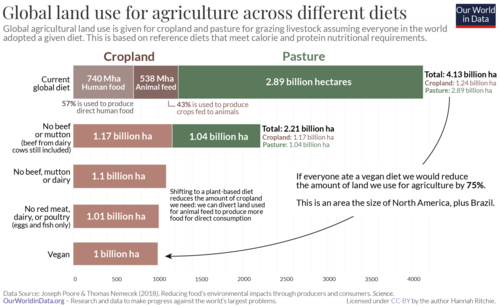
The amount of globally needed agricultural land would be reduced by almost half if no beef or mutton were eaten.
Health-related motivations
Some health-related reasons for adopting a flexitarian diet include weight management,[21] efforts to create a more balanced and healthy diet, as well as general health consciousness. Some individuals decide to reduce meat consumption as part of a broader effort to improve quality of diet and to support long-term health goals.[21][1] Flexitarian diets are also sometimes described as an easier way to follow a mostly plant-based pattern while still allowing occasional meat.[22] Flexitarians are often also motivated by recommendations from public health guidance to limit intake of red meat due to its possible correlation with heart disease, cancer, and diabetes.[23]
Environmental motivations
Some environmental reasons for adopting a flexitarian diet include concerns about excessive resource use and sustainability in the process of meat production. The process of meat production also includes high water and land use requirements, which have been noted as reasons for reducing meat consumption with environmental motivations.[24] Reducing meat consumption is discussed in the context of environmental vegetarianism as well as efforts to lower the environmental footprint of food systems.[6] There are often concerns about climate change that are tied to meat production. Climate change is connected to greenhouse gas emissions that are associated with livestock production.[25][26]
Ethical and economic motivations
Some ethical and economic reasons for adopting a flexitarian diet include religious dietary restrictions, concern for animal welfare or animal rights, and humanitarian considerations. Some individuals reduce meat consumption in order to limit resource use or for reasons associated with economic vegetarianism.[27][28] Flexitarian diets are sometimes viewed as a better way to align everyday food choices with personal values that are related to animal welfare and social responsibility.[29]
Health effects
Flexitarian diets have been studied for their potential health and nutritional effects, though results do seem to vary due to the extremity of each individual's diet. Some studies have found a correlation between the flexitarian diet patterns and health benefits, especially in diets where foods such as fruits, vegetables, and grains are prominent. Research also explains a potential link between the reduction of meat consumption, especially red meats, and lower risks of certain chronic conditions, including type 2 diabetes, and cardiovascular disease.[1][21]
Research has also studied the true nutritional quality of flexitarian diets. While many individuals following flexitarian patterns meet the general nutrient requirements, some studies have reported lower intakes of certain nutrients that are most commonly obtained through animal products. These nutrients include vitamin B12, iron, and vitamin D. These nutritional outcomes do appear to depend on food choices, dietary planning, and the extent to which each individual decides to reduce animal products.[30]
Limitations
There are limitations when it comes to research on flexitarian diets that are related to variation in definitions, and dietary practices. A major limitation of research on flexitarian diets, is the variety in the consumption of meat across individuals. Different studies often have different criteria that classifies individuals as flexitarian. The variable can range from occasional meat reduction to a certain numbers of plant-based days. As a result, different studies can be difficult to compare, meaning that the frequency and health outcomes may vary depending on how flexitarianism is defined.[31]
Another limitation with research on flexitarian diets is that a large amount of the research studying the correlation between health or environmental effects and flexitarian diets is based on observational studies instead of long-term controlled trials. While these studies are definitely useful for identifying certain patterns and potential impacts, they cannot officially establish direct relationships and may rely on assumptions and bias that can vary across studies.[6][32]
Nutritional outcomes linked with flexitarian diets may also differ depending on different food choices and dietary planning. Flexitarian diets that are poorly planned may result in nutrient deficiencies, while diets that are well planned can meet the general nutritional recommendations. This makes it difficult to generalize the health outcomes across all flexitarian populations as no two diets are directly the same.[1]
Varieties
The main fundamental of some specific flexitarian diets is about the inflexible adherence to a diet that omits multiple classes and types of animals from the diet in entirety, rather than a sole focus on reduction in consumption frequency. Some examples include:
Demitarianism: the practice of reducing meat consumption to half of what is culturally typical.[33] The term was devised in October 2009 in Barsac, France combined workshop of Nitrogen in Europe (NinE) and Biodiversity in European Grasslands: Impacts of Nitrogen (BEGIN) where they developed "The Barsac Declaration: Environmental Sustainability and the Demitarian Diet".[34]
Pescetarian diet: someone who follows this diet eats fish and/or shellfish and may or may not consume dairy and eggs. The consumption of other meat, such as poultry, mammal meat, and the flesh of other land-dwelling animals is abstained from.[35] In the past, some vegetarian societies considered it to simply be a less-strict type of vegetarianism.[36] This is no longer the case now that modern-day vegetarian societies object to the consumption of all fish and shellfish.
Pollotarian diet: someone who follows this diet eats chicken and/or other poultry and usually eggs as well. A pollotarian would not consume seafood or the meat from mammals or other animals, often for environmental, health or food justice reasons.[37][38]
Macrobiotic diet: a plant-based diet that may include occasional fish or other seafood.[39] Cereals, especially brown rice, are the staples of the macrobiotic diet, supplemented by small amounts of vegetables and occasionally fish. Some advocates of the macrobiotic diet promote a vegetarian (or nearly vegan) approach as the ideal.[40]
Planetary health diet: dietary paradigms with the following aims: to feed a growing world's population, to greatly reduce the worldwide number of deaths caused by poor diet, and to be environmentally sustainable as to prevent the collapse of the natural world.[32][41]
Dietary pattern
All semi-vegetarians could accurately be described as people who eat a plant-based diet, but there is no firm consensus how infrequently someone would have to eat meat and fish for their diet to be considered a flexitarian diet rather than a regular plant-based diet. Recurring conditions of a flexitarian include consuming red meat or poultry only once a week.[42][43] One study defined semi-vegetarians as consuming meat or fish three days a week.[28] Occasionally, researchers define semi-vegetarianism as eschewing red meat in entirety and flexitarianism as the distinct practice of eating very little meat.[44][45] Semi-vegetarianism/flexitarianism may be the default diet for much of the world, where meals based on plant materials provide the bulk of people's regular energy intake.[46] In many countries, this is often due to financial barriers as higher incomes are associated with diets rich in animal and dairy proteins rather than carbohydrate based staples. One estimate suggests that 14% of the global population is flexitarian.[47]
Society and culture
Flexitarianism has been discussed in public and media conversations about food choice and consumer behavior. This concept is often presented as a more flexible version of vegetarian or vegan diets, which may explain its frequent appearance in lifestyle discussions. In the United Kingdom, there was increased demand for vegan products in 2018, which explains this shift to a reduction of meat intake.[48]
Environmental impact
Flexitarian dietary patterns have been analyzed and research has started to point to a relation to positive environmental impacts, especially compared to diets that are high in red meat. Studies have suggested that dietary patterns that involve reduced consumption of red meat, including flexitarian diets, are associated with lower greenhouse gas emissions compared to typical diets.[6] The environmental impact of diets high in red meat is mainly credited to the intensity of livestock production, which requires a large amount of land, food, and water. Compared with fully plant-based diets, flexitarian patterns result in smaller environmental benefits but represent a much more achievable reduction strategy for many populations.
In 2019, researchers associated with the EAT-Lancet Commission argued that dietary patterns that reduced consumption of animal products, could support environmental sustainability while also meeting global nutritional needs when compared with typical Western diets. However, much of this data is based on modeling analyses, and environmental outcomes could possibly vary depending on each flexitarian's diet.
↑Malesu, Vijay Kumar (11 May 2025). "The Flexitarian Diet: A Flexible Path to Better Health". Medical News. Retrieved 11 August 2025. For example, some individuals may exclude red meat but still consume poultry or fish, whereas others may consume all types of meat in limited amounts, such as once or twice a week.
↑Graham Hill (31 July 2000). "Pescatarian". Oxford. Archived from the original on 9 February 2018. Retrieved 14 April 2019.
↑"International Health Exhibition", The Medical Times and Gazette, 24 May 1884, 712. "There are two kinds of vegetarians—one an extreme form, the members of which eat no animal food whatever; and a less extreme sect, who do not object to eggs, milk, or fish. The Vegetarian Society... belongs to the latter more moderate division."
↑Miller, ER (November 2006). "The effects of macronutrients on blood pressure and lipids: an overview of the DASH and OmniHeart trials". Curr Atheroscler Rep. 8 (6): 460–5. doi:10.1007/s11883-006-0020-1. PMID17045071. S2CID72616374.
This page is based on this Wikipedia article Text is available under the CC BY-SA 4.0 license; additional terms may apply. Images, videos and audio are available under their respective licenses.