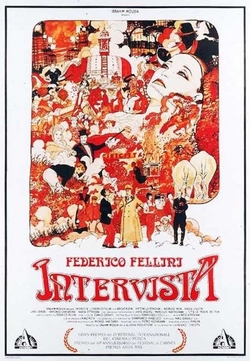
Plot
Interviewed by a Japanese television crew for a news report on his latest film, Fellini takes the viewer behind the scenes at Cinecittà. A nighttime set is prepared for a sequence that Fellini defines as "the prisoner's dream" in which his hands grope for a way out of a dark tunnel. With his advancing age and weight, Fellini is finding it difficult to escape by simply flying away, but when he does, he contemplates Cinecittà from a great height.
The next morning, Fellini accompanies the Japanese TV crew on a brief tour of the studios. As they walk past absurd TV commercials in production, Fellini's casting director presents him with four young actors she's found to interpret Karl Rossmann, the leading role in Fellini's film version of Franz Kafka's novel Amerika. Fellini introduces the Japanese to the female custodian of Cinecittà, Nadia Ottaviani, but she succeeds in putting off the interview by disappearing into the deserted backlot of Studio 5 to gather dandelions to make herbal tea. Meanwhile, Fellini's assistant director Maurizio Mein is on location with other crew members at the Casa del Passeggero, a once cheap hotel now converted into a drugstore. Fellini wants to include it in his film about the first time he visited Cinecittà as a journalist in 1938 during the Fascist era. [1]
Past and present intermingle as Fellini interacts with his younger self played by aspiring actor Sergio Rubini. After the crew reconstruct the facade of the Casa del Passeggero elsewhere in Rome, a fake tramway takes young Fellini/Rubini from America's Far West with Native American warriors on a clifftop to a herd of wild elephants off the coast of Ethiopia. Arriving at Cinecittà, he sets off to interview matinee idol, Katya, a character representing actress Greta Gonda, [2] with whom he had conducted his very first interview.
Seamlessly, the illusion takes over the realities of filmmaking as the viewer is thrown into two feature films being directed by tyrannical directors, but only for a short while; for the rest of the film, Fellini and Mein scramble to recruit the right cast and build the sets for Amerika, a fictitious adaptation that Fellini uses as a pretext to shoot his film-in-progress. This allows Fellini/Rubini to go back and forth in time to experience filmmaking first-hand, including disgruntled actors who failed their auditions, Marcello Mastroianni in a commercial as Mandrake the Magician, a bomb threat, a visit to Anita Ekberg's house where she and Mastroianni relive their La Dolce Vita scenes, screen tests of Kafka's Brunelda being caressed in a bathtub by two young men, and an inconvenient thunderstorm that heralds the production collapse of Amerika with an attack by bogus Native Americans on horseback wielding television antennae as spears.
Back inside Studio 5 at Cinecittà, Intervista concludes with Fellini's voiceover: "So the movie should end here. Actually, it's finished." In response to producers unhappy with his gloomy endings, Fellini ironically offers them a ray of sunshine by lighting an arc lamp.
Production
American filmmaker David Lynch was present during a day of filming, which he described in his 2019 MasterClass series:
One day on the first year of the Center for Advanced Film Studies, Toni Villani asked me to come up to his office and in his office was Roberto Rossellini. And we started talking together. And pretty soon, [Rossellini] invited me to Rome to go to his school, Centro Sperimentale. And I was seriously considering that move. And I probably would've gone there, except his school ran out of money and I stayed at the American Film Institute. Later, I met Isabella Rossellini, his daughter, and we started going together. And one day, Isabella got a film job with a Russian director. I think the thing was called Dark Eyes and it was being shot south of Rome. [...] Isabella and Silvana Mangano, who was in the film as well, and I went to dinner. And Silvana invited Marcello Mastroianni. [...] All this time, it was Marcello telling us stories about Fellini, and me telling Marcello how much I loved Fellini. The next morning, I come out of my hotel and there's a big limousine—a Mercedes and a driver. And Marcello had orchestrated this thing that I got to go into Rome and spend the entire day with [Fellini] while he was shooting his film Intervista. And that was a thrill beyond the beyond. [3]
This page is based on this
Wikipedia article Text is available under the
CC BY-SA 4.0 license; additional terms may apply.
Images, videos and audio are available under their respective licenses.