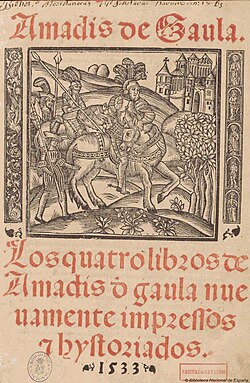
A knight-errant[1] (or knight errant[2]) is a figure of medieval chivalric romance literature. The adjective errant (meaning "wandering, roving") indicates how the knight-errant would wander the land in search of adventures to prove his chivalric virtues, either in knightly duels (pas d'armes) or in some other pursuit of courtly love.
The knight-errant is a character who has broken away from the world of his origin, in order to go off on his own to right wrongs or to test and assert his own chivalric ideals. In medieval Europe, knight-errantry existed in literature, though fictional works from this time often were presented as non-fiction.[3][4]
The character of the wandering knight existed in romantic literature as it developed during the late 12th century. However, the term "knight-errant" was to come later; its first extant usage occurs in the 14th-century poem Sir Gawain and the Green Knight.[5]
The protagonist of Cormac McCarthy's novel All the Pretty Horses, John Grady Cole, is said to be based specifically on Sir Gawain, of Sir Gawain and the Green Knight. Both characters share a number of aspects and traits; both are rooted in the myths of a past that no longer exists, and both live by codes of conduct from a previous era.[7]
In Jean Giraudoux's play Ondine, which starred Audrey Hepburn on Broadway in 1954, a knight-errant appears, during a storm, at the humble home of a fisherman and his wife.[8]
The protagonist of Lee Child's novels, Jack Reacher, is intended by the author as a modern-day reflection of classic lone heroes.[9]
↑As plural, knights-errant is most common, although the form knights-errants is also seen, e.g. in the article Graal in James O. Halliwell, Dictionary of Archaic and Provincial Words (1847).
↑"Knight errant." The Canadian Oxford Dictionary. Ed. Barber, Katherine: Oxford University Press, 2004.
↑Daniel Eisenberg, "The Pseudo-Historicity of the Romances of Chivalry", Quaderni Ibero-Americani, 45–46, 1974–75, pp. 253–259.
↑Sir Gawain arrives at the castle of Sir Bercilak de Haudesert after long journeys, and Sir Bercilak goes to welcome the "knygt erraunt." The Maven's Word of the Day: Knight Errant
↑Lacy, Norris J. (1996). The New Arthurian Encyclopedia. Garland Publishing.
This page is based on this Wikipedia article Text is available under the CC BY-SA 4.0 license; additional terms may apply. Images, videos and audio are available under their respective licenses.