Mount Carillon

Last updated

Mount Carillon
Mt. Carillon.jpg
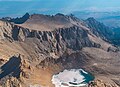
Mt. Carillon centered at top, south aspect
(Mt. Russell in upper left corner)
Highest point
Elevation 13,559 ft (4,133 m) NAVD 88 [1]
Prominence 233 ft (71 m) [1]
Parent peak Mount Russell (14,088 ft) [1]
Isolation 0.41 mi (0.66 km) [1]
Listing Sierra Peaks Section
Coordinates 36°35′33″N118°16′40″W / 36.5924211°N 118.2779091°W / 36.5924211; -118.2779091 [2]
Naming
Etymology Carillon
Geography
Relief map of California.png
Red triangle with thick white border.svg
Mount Carillon
Usa edcp relief location map.png
Red triangle with thick white border.svg
Mount Carillon
Location Sequoia National Park
Tulare County / Inyo County
California, U.S.
Parent range Sierra Nevada
Topo map USGS Mount Whitney
Geology
Rock age Cretaceous
Mountain type Fault block
Rock type granitic
Climbing
First ascent 1925, Norman Clyde
Easiest route Simple scramble class 2+ [3]

Mount Carillon is a 13,559-foot-elevation (4,133-meter) mountain summit located on the crest of the Sierra Nevada mountain range in California. [2] It is situated on the common border of Tulare County with Inyo County, as well as the shared boundary of Sequoia National Park and John Muir Wilderness. It is set above the south shore of Tulainyo Lake, 12.5 miles (20.1 km) west of the community of Lone Pine, 1.25 miles (2.01 km) northeast of Mount Whitney, and 0.7 miles (1.1 km) east-northeast of Mount Russell, the nearest higher neighbor. Topographic relief is significant as it rises approximately 5,180 feet (1,580 meters) above Whitney Portal in approximately two miles. Carillon has subpeaks, unofficially called "The Cleaver" (13,383 ft (4,079 m), 0.4 mile to the northeast, and "Impala" (12,073+ ft/3,680+ m), on the southeast ridge. [1]

Contents

History

The first ascent of the summit was made in 1925, by Norman Clyde, who is credited with 130 first ascents, most of which were in the Sierra Nevada. [4] [5] The peak's name was submitted by Chester Versteeg of the Sierra Club, and officially adopted by the United States Board on Geographic Names in 1937. [2] It is so named because it is shaped like a bell tower, which often houses a carillon. [6]

Climate

According to the Köppen climate classification system, Mount Carillon has an alpine climate. [7] Most weather fronts originate in the Pacific Ocean, and travel east toward the Sierra Nevada mountains. As fronts approach, they are forced upward by the peaks, causing them to drop their moisture in the form of rain or snowfall onto the range (orographic lift). Precipitation runoff from this mountain drains west to the Kern River via Wallace Creek, and east to Owens Valley via Lone Pine Creek.

Climbing

Established climbing routes: [8]

See also

References

  1. 1 2 3 4 5 "Mount Carillon, California". Peakbagger.com. Retrieved May 21, 2021.
  2. 1 2 3 "Mount Carillon". Geographic Names Information System . United States Geological Survey, United States Department of the Interior . Retrieved May 21, 2021.
  3. Roper, Steve (1976). The Climber's Guide to the High Sierra. San Francisco: Sierra Club Books. p. 304. ISBN   978-0871561473.
  4. Mendenhall, John D. and Ruth; Johnson, Arthur B.; Gigas, Braeme; Koster, Howard (1954). "A Climber's Guide to the High Sierra". Yosemite Online. Retrieved November 5, 2021.
  5. "Norman Clyde - Mountaineer". OwensValleyHistory.com. Retrieved November 5, 2021.
  6. Gudde, Erwin G. (1969). California Place Names. University of California Press. p. 66. ISBN   978-0520266193.
  7. Peel, M. C.; Finlayson, B. L.; McMahon, T. A. (2007). "Updated world map of the Köppen−Geiger climate classification". Hydrol. Earth Syst. Sci. 11 (5): 1633. Bibcode:2007HESS...11.1633P. doi: 10.5194/hess-11-1633-2007 . ISSN   1027-5606.
  8. Secor, R.J. (2009). The High Sierra Peaks, Passes, and Trails (3rd ed.). Seattle: The Mountaineers. p. 254. ISBN   978-0898869712.
  9. Har-Noy, Shay (2009). "Mt. Carillon, Sweet Carillon and Pipe-Line". American Alpine Journal. Retrieved November 5, 2021.