The earliest omelettes are believed to have been cooked in ancient Persia.[1][2]:65 According to Breakfast: A History, they were "nearly indistinguishable" from the Iranian dish kookoo sabzi, a Persian version of a frittata.[2]
According to Alan Davidson,[1] the French word omelette (French:[ɔm.lɛt]) came into use during the mid-16th century, but the versions alumelle and alumete are employed by the Ménagier de Paris (II, 4 and II, 5) in 1393.[3]Rabelais (Gargantua and Pantagruel, IV, 9) mentions an homelaicte d'oeufs,[4] Olivier de Serres an amelette, François Pierre La Varenne's Le cuisinier françois (1651) has aumelette, and the modern omelette appears in Cuisine bourgeoise (1784).[5]
Alexandre Dumas discusses several variations of omelette in his Grand dictionnaire de cuisine. One is an omelette with fresh herbs (parsley, chives and tarragon), and another is a variation with mushrooms that Dumas says may be adapted using green peas, asparagus, spinach, sorrel or varieties of truffles. The "kirsch omelette" (or rum omelette) is a sweet omelette made with sugar and liquor, either kirsch or rum. The omelette is rolled and sprinkled with powdered sugar. A hot poker is used to burn a design into the omelette and it is served with a sweet sauce made of liquor and apricot jam. Another sweet omelette, attributed to a royal cook of Prussia, is made with apples and brown sugar glaze. Of the Arabian omelette, Dumas writes, "I have been concerned in this book to give the recipes of peoples who have no true cuisine. Here, for example, is a recipe the Bey's cook was good enough to give me." The omelette itself is made with an ostrich egg and served with a spicy tomato-pepper sauce.[6]
†Percentages estimated using USrecommendations for adults,[7] except for potassium, which is estimated based on expert recommendation from the National Academies.[8]
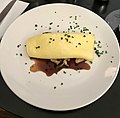
Depending on sources, a standard omelette is cooked in butter on medium (or sometimes high[10]) heat,[11] is supposed to be golden brown[10] or "unbrowned or very lightly browned"[11] on the outside and soft in the inside[10] (though variations are possible according to preference[11]); according to some American cookbooks reflecting high-end restaurant practices, a "French Omelette" should be unbrowned, cooked slowly over medium-low to medium heat, with initial stirring to prevent curds and sticking.[12] Seasoned with just salt and pepper, this omelette is often flavored with finely chopped herbs (often fines herbes[13] or tarragon, chervil, parsley and chives) or chopped onions.
The omelette de la mère Poulard, a Norman specialty first developed in Mont-Saint-Michel, has been called the most famous omelette in the world. It is served without fillings but often served with heavy garnishes.[14]
The Provençal omelette is more similar to a frittata than to a traditional rolled or folded French omelette.[15] The eggs are cooked like a traditional French omelette until the time any fillings are added; instead of adding fillings in a strip or on half the omelette, they are scattered over the entire surface of the omelette, and then the entire omelette is flipped and slipped back into the pan to cook what had been the top and is now the bottom.[15] A tourne omelette or vire omelette, a concave platter similar to a cake plate, is often used as an aid and can be used to serve the finished omelette.[15] According to Bernard Duplessy the tourne omelette dates to "several centuries before Christ".[15]
Crespéou, another Provençal dish (also called gâteau d'omelettes or omelettes en sandwich), is made by stacking open-faced omelettes.[16][17]
In Parsi cuisine, pora is an omelette made from eggs, onion, tomato, green chillies, and coriander leaves.[18] It is usually served for breakfast with Indian/Irani tea and bread.
In India, eggs are beaten with onions and poured directly on a hot pan with salt and pepper. These omelettes are consumed frequently in many Indian households.
Bread Omelette is a snack made with bread and egg that is widespread across India.[citation needed]
In South Indian hotels, omelettes may be mixed with mutton gravy (salna) in a semi-cooked manner, and many omelette variants like kalakki, plain omelettes, Karandi omelettes, and Podi omelettes are found in Tamil Nadu.[citation needed]
Indonesia
In Betawi cuisine, kerak telor is a traditional spicy omelette that made from glutinous rice cooked with egg and served with serundeng (fried shredded coconut), fried shallots and dried shrimp as topping.
Fuyunghai or puyonghai is a Chinese Indonesian omelette, usually made from the mixture of vegetables such as carrots, bean sprouts, and cabbages, mixed with meats such as crab, shrimp, or minced chicken.
Iranian omelette is an omelette differing from its European counterpart in that it contains tomatoes, tomato paste and frequently other ingredients such as fried onions.
Kuku is an omelette frequently containing large proportions of other ingredients, including herbs, folded in.
Nargesi or spinach omelette is an Iranian dish, made with fried onions and spinach, and is spiced with salt, garlic, and pepper.[19][20]
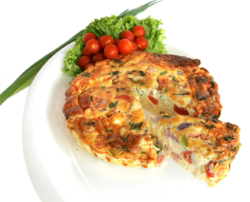
A frittata is an open-faced Italian omelette-like dish that can contain cheese, vegetables, or even leftover pasta. Frittatas are cooked slowly. Except for the cooking oil, all ingredients are fully mixed with the eggs before cooking starts.
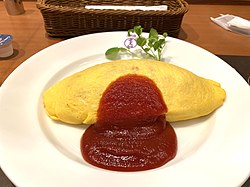
Omurice (from the French word "omelette" and English word "rice") is an omelette filled with fried rice and usually served with a large amount of tomato ketchup. Omu-soba is an omelette with yakisoba as its filling. There are several styles of this dish, including omelette cooked and filled with fried rice, a soft-cooked omelette served over the fried rice that is then sliced open, and a "tornado" style omelette over the rice.
In Korean cuisine, traditional omelettes are known as gyeran-mari (계란말이, "rolled-eggs") which is a type of savory banchan. Gyeran-mari is made with beaten eggs, mixed with finely diced vegetables, meats, and seafood. This side dish is often found in Korean banquet (janchi) meals, as well as Korean fast food (bunsik) restaurants.
While the Spanish terms tortilla (in Spain) and torta (in the Philippines) are applied to an omelette dish, in Mexico and Central America tortilla is a term for a flatbread made of wheat or corn, while torta is used for a type of sandwich. An omelette in Mexico (and Central America) is sometimes called tortilla de huevos, but the term omelette is widely used.[citation needed]
Philippines
In the Philippines, omelettes are known as torta, usually encountered with the enclitic-ng ("tortang") indicating it modifies the next word (the main ingredient); e.g. tortang hipon = torta ("omelette") + -ng and hipon ("shrimp"), meaning "shrimp omelette". There are many types of torta which are named based on their main ingredients. They include:
Tortang alamang or tortang hipon[22]– an omelette with krill or small shrimp. Also known as shrimp fritters,[23] although this term usually refers to okoy, a fritter made with shrimp and various vegetables (as well as other variations without shrimp).
Tortang dulong or maranay– an omelette, usually crispy, made with tiny fish from the family Salangidae known as dulong in Tagalog and ipon, libgao, or maranay in Visayan.[24][25] It is sometimes called okoy, though traditional okoy is not an omelette, but rather a type of fritter made with glutinous rice.
Tortang giniling or tortang picadillo– an omelette with ground meat (usually beef or pork) and sautéed vegetables.[26]
Tortang gulay– an omelette with peppers, mushrooms, onion, and garlic.
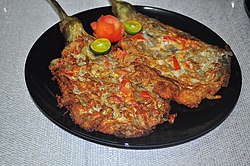
Tortang talong– an eggplant omelet with whole grilled eggplants. Versions stuffed with ground meat (giniling) and vegetables are called relyenong talong.
Foustoron is an omelette made by the Pontic Greeks.[28]Foustoron is made with eggs fried in butter or oil; the omelette can be served plain or seasoned. Some modern varieties include yogurt and cheese. The recipe varied widely by region: some recipes included onion and dried red peppers, while others did not.[citation needed]
Spain
The Spanishtortilla de patatas, or tortilla española in other Spanish-speaking countries, is a traditional and very popular thick omelette containing sliced potatoessautéed in cooking oil. It often includes sliced onions (tortilla de patata con cebolla) and less commonly other additional fillings, such as cheese, bell peppers, or diced ham.
In Thai cuisine, a traditional omelette is called khai jiao ไข่เจียว (khai meaning "egg", and jiao meaning fried), in which the beaten egg mixture and a small quantity of fish sauce is deep fried in a wok filled with 1–2 cups of vegetable oil and served over steamed rice. The dish is usually served with Sriracha sauce and cilantro. A variation on this dish is khai chiao songkhrueang, where the plain egg omelette is served together with a stir-fry of meat and vegetables. Yet another type of Thai omelette is khai yat sai, literally "eggs filled with stuffing".[29]
The Denver omelette, also known as a Southwest omelette or Western omelette,[34] is filled with diced ham, onions, and green bell peppers,[35][citation needed] though there are many variations on fillings. Often served in the Southwestern United States, it sometimes has a topping of cheese and a side dish of hash browns or fried potatoes.[36]
↑"En pareille alliance, l'un appeloit une sienne, mon homelaicte. Elle le nommoit mon oeuf, et estoient alliés comme une homelaicte d'oeufs".
↑Three noted by Maguelonne Toussaint-Samat, (Anthea Bell, tr.) A History of Food, revised ed, 2009, p. 326; de Serres note "Le glossaire accadien"Archived July 19, 2011, at the Wayback Machine
123Ginette Mathiot (éd), La Cuisine pour tous, 1955, p.107: "(...) laissez cuire à feu vif. L'omelette doit être dorée à l'extérieur, baveuse au centre."
↑Merano, Manjo (14 June 2010). "Tortang Giniling Recipe". Pansalang Pinoy. Archived from the original on February 14, 2015. Retrieved February 12, 2015.
12Ayto, John. "Arnold Bennett", The Diner's Dictionary, Oxford University Press, 2012. Retrieved 3 June 2020 (subscription required)Archived 3 June 2020 at the Wayback Machine
This page is based on this Wikipedia article Text is available under the CC BY-SA 4.0 license; additional terms may apply. Images, videos and audio are available under their respective licenses.