Superpower describes a sovereign state or supranational union that holds a dominant position characterized by the ability to exert influence and project power on a global scale.[1][2][3] This is done through the combined means of economic, military, technological, political, and cultural strength as well as diplomatic and soft power influence. Traditionally, superpowers are preeminent among the great powers. While a great power state is capable of exerting its influence globally, superpowers are states so influential that no significant action can be taken by the global community without first considering the positions of the superpowers on the issue.[4]
No agreed definition of what a superpower is exists and may differ between sources.[8] However, a fundamental characteristic that is consistent with all definitions of a superpower is a nation or state that has mastered the seven dimensions of state power, namely geography, population, economy, resources, military, diplomacy, and national identity.[16]
The term was first used to describe nations with greater than great power status as early as 1944, but only gained its specific meaning with regard to the United States and the Soviet Union after World War II. This was because the United States and the Soviet Union had proved themselves to be capable of casting great influence in global politics and military dominance. The term in its current political meaning was coined by Dutch-American geostrategistNicholas Spykman in a series of lectures in 1943 about the potential shape of a new post-war world order. This formed the foundation for the book The Geography of the Peace, which referred primarily to the unmatched maritime global supremacy of the British Empire and the United States as essential for peace and prosperity in the world.[citation needed]
A year later, William T. R. Fox, an American foreign policy professor, elaborated on the concept in the book The Superpowers: The United States, Britain and the Soviet Union – Their Responsibility for Peace which spoke of the global reach of a super-empowered nation.[17] Fox used the word superpower to identify a new category of power able to occupy the highest status in a world in which—as the war then raging demonstrated—states could challenge and fight each other on a global scale. According to him, at that moment, there were three states that were superpowers, namely the United States, the Soviet Union, and the United Kingdom. The British Empire was the most extensive empire in world history and considered the foremost power, holding sway over 25% of the world's population[18] and controlling about 25% of the Earth's total land area, while the United States and the Soviet Union grew in power before and during World War II. The UK would face serious political, financial, and colonial issues after World War II that left it unable to match Soviet or American power. Ultimately, Britain's empire would gradually dissolve over the course of the 20th century, sharply reducing its global power projection.
According to Lyman Miller, "[t]he basic components of superpower stature may be measured along four axes of power: military, economic, political, and cultural (or what political scientist Joseph Nye has termed 'soft power')".[19]
In the opinion of Kim Richard Nossal of Queen's University in Canada, "generally, this term was used to signify a political community that occupied a continental-sized landmass; had a sizable population (relative at least to other major powers); a superordinate economic capacity, including ample indigenous supplies of food and natural resources; enjoyed a high degree of non-dependence on international intercourse; and, most importantly, had a well-developed nuclear capacity (eventually, normally defined as second strike capability)".[8]
In the opinion of Professor Paul Dukes, "a superpower must be able to conduct a global strategy, including the possibility of destroying the world; to command vast economic potential and influence; and to present a universal ideology", although "many modifications may be made to this basic definition".[20] According to Professor June Teufel Dreyer, "[a] superpower must be able to project its power, soft and hard, globally".[21] In his book Superpower: Three Choices for America's Role in the World, Dr. Ian Bremmer, president of the Eurasia Group, argues that a superpower is "a country that can exert enough military, political, and economic power to persuade nations in every region of the world to take important actions they would not otherwise take".[22]
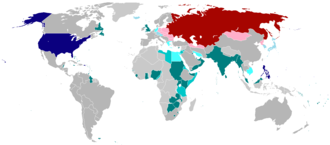
Socialist states allied with the Soviet Union and the Warsaw Pact
Other allies of the Soviet Union
× Communist guerrillas
Socialist states not allied with the Soviet Union and the Warsaw Pact
Neutral nations
× Other conflicts
The 1956 Suez Crisis suggested that Britain, financially weakened by two world wars, could not then pursue its foreign policy objectives on an equal footing with the new superpowers without sacrificing convertibility of its reserve currency as a central goal of policy.[24] As the majority of World War II had been fought far from its national boundaries, the United States had not suffered the industrial destruction nor massive civilian casualties that marked the wartime situation of the countries in Europe or Asia. The war had reinforced the position of the United States as the world's largest long-term creditor nation[25] and its principal supplier of goods; moreover, it had built up a strong industrial and technological infrastructure that had greatly advanced its military strength into a primary position on the global stage.[26] Despite attempts to create multinational coalitions or legislative bodies (such as the United Nations), it became increasingly clear that the superpowers had very different visions about what the post-war world ought to look like and after the withdrawal of British aid to Greece in 1947, the United States took the lead in containingSoviet expansion in the Cold War.[27]
The two countries opposed each other ideologically, politically, militarily, and economically. The Soviet Union promoted the ideology of Marxism–Leninism, planned economy, and a one-party state while the United States promoted the ideologies of liberal democracy and the free market in a capitalistmarket economy. This was reflected in the Warsaw Pact and NATO military alliances, respectively, as most of Europe became aligned with either the United States or the Soviet Union. These alliances implied that these two nations were part of an emerging bipolar world, in contrast with a previously multipolar world.[28]
The idea that the Cold War period revolved around only two blocs, or even only two nations, has been challenged by some scholars in the post–Cold War era, who have noted that the bipolar world only exists if one ignores all of the various movements and conflicts that occurred without influence from either of the two superpowers.[29] Additionally, much of the conflict between the superpowers was fought in proxy wars, which more often than not involved issues more complex than the standard Cold War oppositions.[30]
After the Soviet Union disintegrated in the early 1990s, the term "hyperpower" began to be applied to the United States as the sole remaining superpower of the Cold War era.[8] This term, popularized by French foreign minister Hubert Védrine in the late 1990s, is controversial and the validity of classifying the United States in this way is disputed. One notable opponent to this theory is Samuel P. Huntington, who rejects this theory in favor of a multipolar balance of power. Other international relations theorists such as Henry Kissinger theorize that because the threat of the Soviet Union no longer exists to formerly American-dominated regions such as Western Europe and Japan, American influence is only declining since the end of the Cold War because such regions no longer need protection or have necessarily similar foreign policies as the United States.[31]
After the dissolution of the Soviet Union in 1991 which ended the Cold War, the post–Cold War world has in the past been considered by some to be a unipolar world,[32][33] with the United States as the world's sole remaining superpower.[34] In 1999, political scientist and author Samuel P. Huntington wrote: "The United States, of course, is the sole state with preeminence in every domain of power – economic, military, diplomatic, ideological, technological, and cultural – with the reach and capabilities to promote its interests in virtually every part of the world". However, Huntington rejected the claim that the world was unipolar, arguing: "There is now only one superpower. But that does not mean that the world is unipolar", describing it instead as "a strange hybrid, a uni-multipolar system with one superpower and several major powers". He further wrote that "Washington is blind to the fact that it no longer enjoys the dominance it had at the end of the Cold War. It must relearn the game of international politics as a major power, not a superpower, and make compromises".[35]
Experts argue that this older single-superpower assessment of global politics is too simplified, in part because of the difficulty in classifying the European Union at its current stage of development. Others argue that the notion of a superpower is outdated, considering complex global economic interdependencies and propose that the world is multipolar.[36][37][38][39]
A 2012 report by the National Intelligence Council predicted that the United States superpower status will have eroded to merely being first among equals by 2030, but that it would remain highest among the world's most powerful countries because of its influence in many different fields and global connections that the great regional powers of the time would not match.[40] Additionally, some experts have suggested the possibility of the United States losing its superpower status completely in the future, citing speculation of its decline in power relative to the rest of the world, economic hardships, a declining dollar, Cold War allies becoming less dependent on the United States, and the emergence of future powers around the world.[41][42][43]
According to a RAND Corporation paper by American diplomat James Dobbins, Professor Howard J. Shatz, and policy analyst Ali Wyne, Russia in the breakdown of a disintegrating unipolar world order, while not a peer competitor to the United States, would still remain a player and a potential rogue state that would undermine global affairs. The West could contain Russia with methods like those employed during the Cold War with the Soviet Union, though this would be tested by Russia's overt and covert efforts to destabilize Western alliances and political systems. On the other hand, China is a peer competitor to the United States that cannot be contained, and will be a far more challenging entity for the West to confront. The authors state that China's military dominance in the Asia-Pacific is already eroding American influence at a rapid pace, and the costs for the US to defend its interests there will continue to rise. Moreover, China's economic influence has already broken out of its regional confines long ago and is on track to directly contest the US role as the center for economic trade and commerce.[44][45][46][47]
Potential superpowers
The term potential superpowers has been applied by scholars and other qualified commentators to the possibility of several political entities achieving superpower status.
Potential superpowers—supported in varying degrees by academics
China
European Union
Russia
India
Due to their large markets, growing military strength, economic potential, and influence in international affairs, China,[49][50][51] the European Union,[2] Russia,[52] and India[53] are among the political entities most cited as having the potential of achieving superpower status in the 21st century. In 2020, a new UBS survey found that 57% of global investors predicted that China would replace the U.S. as the world's biggest superpower by 2030.[54] However, in 2012, many historians, writers, and critics have expressed doubts about whether China or India would ever emerge as a new superpower.[55][56] In 2013, some political scientists and other commentators have even suggested that such countries might simply be emerging powers, as opposed to potential superpowers.[57] In 2020, the European Union has been called a "regulatory superpower" due to the Brussels effect.[58][59][60]
Increasing doubts have emerged in 2022 around the potential of Russia to gain superpower status given its declining economy, severe military underperformance during the invasion of Ukraine, and its loss of influence in Central Asia, a region once dominated by Moscow for centuries.[61][62][63]
The Suez Crisis in particular is regarded by historians to be a political and diplomatic disaster for the British Empire, as it led to large-scale international condemnation, including extensive pressure from the United States and Soviet Union. This forced the British and the French to withdraw in embarrassment and cemented the increasingly-bipolar Cold War politics between the Soviet Union and United States. In the 1960s, the movement for decolonization reached its peak, with remaining imperial holdings achieving independence, accelerating the transition from the British Empire to the Commonwealth of Nations. As the Empire continued to crumble, the home islands of the United Kingdom later experienced deindustrialization throughout the 1970s, coupled with high inflation and industrial unrest that unraveled the postwar consensus. This led to some economists to refer to Britain as the Sick Man of Europe. In 1976, the United Kingdom had to seek assistance from the International Monetary Fund (IMF) which it had previously ironically helped create, receiving funding of $3.9billion, the largest-ever loan to be requested up until that point.[71][72] In 1979, the country suffered major widespread strikes known as the Winter of Discontent. All these factors were seen by academics, economists and politicians as symbolising Britain's postwar decline. Lastly, the Handover of Hong Kong to China in July 1997 was seen by experts as the definitive end of the British Empire.
Nevertheless, the United Kingdom today has retained global soft power in the 21st century. Its capital city, London, continues to be regarded as one of the pre-eminent cities in the world, being ranked as a global city by the Mori Foundation.[73] In 2022, the United Kingdom was ranked the foremost European country in terms of soft power by Brand Finance.[74] The United Kingdom also retains a formidable military and is one of the recognized nuclear-weapons states.
In After the Empire: The Breakdown of the American Order[75] (2001), French sociologist Emmanuel Todd predicts the eventual decline and fall of the United States as a superpower. "After years of being perceived as a problem-solver, the US itself has now become a problem for the rest of the world." Since the 2010s, as a result of asymmetric polarization within the United States, as well as globally perceived U.S. foreign policy failures, and China's growing influence around the world, some academics and geopolitical experts have argued that the United States may already be experiencing a decay in its soft power around the world.[76][77]
Superpower disengagement
Superpower disengagement is a foreign policy option whereby the most powerful nations, the superpowers, reduce their interventions in an area. Such disengagement could be multilateral among superpowers or lesser powers, or bilateral between two superpowers, or unilateral. It could mean an end to either direct or indirect interventions. For instance, disengagement could mean that the superpowers remove their support of proxies in proxy wars to de-escalate a superpower conflict back to a local problem based on local disputes. Disengagement can create buffers between superpowers that might prevent conflicts or reduce the intensity of conflicts.[citation needed]
The term usually refers to various policy proposals during the Cold War which attempted to defuse tensions between the Soviet Union and the United States, largely because of the risk of any superpower conflict to escalate to nuclear war. Examples of one-sided disengagement include when Joseph Stalin decided to end Soviet support for the communist guerrillas in Greece during the Greek Civil War, and when Richard Nixon withdrew US troops from Vietnam in the early 1970s.[citation needed]
The more important candidates for disengagement were where Soviet and US forces faced each other directly such as in Germany and Austria. The Austrian State Treaty is an example of formal, multilateral, superpower disengagement which left Austria as neutral for the duration of the Cold War, with Austria staying out of the Warsaw Pact, NATO, and the European Economic Community. The 1952 Stalin Note is perhaps the most controversial proposal of superpower disengagement from Germany.[78][79]
Proposed early superpowers
These are proposed examples of ancient or historical superpowers, taking into account that the knowledge of what the "known world" comprised was extremely limited in past eras (for example, Europeans became aware of the existence of the Americas and Australia only after the Age of Discovery, which began in the late 15th century, and prior to this era, they had a very limited knowledge about East Asia as well).[80]
Many of the nations of this historical period were never superpowers, however they were regional powers with influence in their respective regions.
Note: Does not take into account city-states and stateless nomadic peoples.
Bronze Age
Fertile Crescent in the Early Bronze Age
In the early history of both regions contact between these civilization was very limited, long distance trade definitely occurred but primarily through long chains of intermediaries rather than directly.
Akkadian Empire (isolated civilization; first empire recorded in history)
Regular contact between Egypt, Mesopotamia and Anatolia dates from this period. Mitanni was an important intermediary in the trade between these civilizations.
Contact with other civilizations was very limited; long distance trade with Mesopotamia definitely occurred but primarily through long chains of intermediaries rather than directly.
Indus Valley Civilisation (isolated civilization, no consensus on whether it was a unified state or not)
Carolingian Empire (Arabs, Persians, East Asians used "Franks" as a generic name for Europeans. Due to feudalism, Western European powers with influence outside Europe did not emerge in the remainder of the Middle Ages)
During the Middle Ages the region was known by Arab merchants. Europeans were aware that the region existed (to the point that Mansa Musa was mentioned in the Catalan Atlas), but little information about the place reached Europe.
The contact between distant civilizations was highly facilitated as well as the mapping of a large part of the planet, with people in this historical period having a better understanding of the global map of the Planet Earth.[101]
According to historical statistics and research from the OECD, until the early modern period, Western Europe, China, and India accounted for roughly two thirds of the world's GDP.[113]
↑Dreyer, June Teufel (February 2007). "Chinese Foreign Policy"(PDF). Footnotes. Vol.12, no.5. Foreign Policy Research Institute. Archived from the original(PDF) on 30 September 2023. Retrieved 31 May 2015.
↑Adam Klug and Gregor W. Smith, 'Suez and Sterling', Explorations in Economic History, Vol. 36, No. 3 (July 1999), pp. 181–203.
↑"Getting Serious About the Twin Deficits "by Author: Menzie D. Chinn – September 2005 by Council on Foreign Relations Press Archived 2 April 2012 at the Wayback Machine
↑Meredith, R (2008) The Elephant and the Dragon: The Rise of India and China and What it Means for All of Us, "W.W Norton and Company" ISBN978-0-393-33193-6
↑"How Rome fell: death of a superpower". Choice Reviews Online. 47 (7): 47–3968-47-3968. 1 March 2010. doi:10.5860/choice.47-3968 (inactive 1 July 2025). ISSN0009-4978.{{cite journal}}: CS1 maint: DOI inactive as of July 2025 (link)
↑Burbank, Jane (5 July 2011). Empires in world history: power and the politics of difference. Princeton University Press. ISBN978-0-691-15236-3. OCLC751801141.
↑"Colonialism: an international, social, cultural, and political encyclopedia". Choice Reviews Online. 41 (7): 218. 1 March 2004. doi:10.5860/choice.41-3809 (inactive 1 July 2025). ISSN0009-4978.{{cite journal}}: CS1 maint: DOI inactive as of July 2025 (link)
Erik Ringmar, "The Recognition Game: Soviet Russia Against the West," Cooperation & Conflict, 37:2, 2002. pp.115–36. – an explanation of the relations between the superpowers in the 20th century based on the notion of recognition.
Sicilia, David B.; Wittner, David G. Strands of Modernization: The Circulation of Technology and Business Practices in East Asia, 1850–1920 (University of Toronto Press, 2021) online review
Todd, Emanuel (200X). After the Empire – The Breakdown of the American Order.
Védrine, Hubert. France in an Age of Globalization, Brookings Institution Press, 2001. ISBN0-8157-0007-5.
Li, Bo; Zheng Yin (Chinese) (2001) 5000 years of Chinese history, Inner Mongolian People's publishing corp, ISBN7-204-04420-7.
External links
Wikimedia Commons has media related to Superpowers.
This page is based on this Wikipedia article Text is available under the CC BY-SA 4.0 license; additional terms may apply. Images, videos and audio are available under their respective licenses.