The Utah National Guard (UNTG) is part of the National Guard of the United States, a dual federal-state military reserve force in the state of Utah. It is headquartered at Joint Force Headquarters, Draper, Utah. At the call of the Governor, the Utah National Guard will mobilize and deploy during times of state emergency to augment local jurisdictions and responders in their efforts to protect lives and property. The Utah National Guard is also subject to the call of the President of the United States to serve as part of the total U.S. Military force.
151st Intelligence, Surveillance, and Reconnaissance Group
169th Intelligence Squadron
151st Intelligence Support Squadron
130th Engineering Installation Squadron
151st Mission Support Group
151st Civil Engineering Squadron
151st Logistics Readiness Squadron
151st Security Forces Squadron
151st Force Support Squadron
151st Communications Squadron
History
3rd Infantry Regiment, Nauvoo Legion, circa 1865.
The Nauvoo Legion
The origins of the Utah National Guard are linked to the Nauvoo Legion, a militia created in 1840 by The Church of Jesus Christ of Latter-day Saints in Illinois. Following the church's migration to the west, the Legion was formally re-established in 1852 under Utah's territorial laws. This effort was largely driven by veterans of the Mormon Battalion, who had previously served in the Mexican-American War, and it provided a formal militia for the territory.[1]
The Nauvoo Legion was active in several key historical moments in Utah, such as the Utah War of 1857-1858 and various conflicts with local Native American tribes. However, the federal Edmunds-Tucker Act of 1887 led to its official disbandment. By 1894, the modern Utah National Guard was organized, becoming the state's officially sanctioned military body.[1]
Establishment of the Utah National Guard
New soldiers of the Utah National Guard march in downtown Salt Lake City, Utah, after its formation in 1894.
The Utah National Guard was officially founded in Salt Lake City on March 26, 1894, with the creation of its first two infantry companies and an artillery battery. Not long after, in April 1894, the Guard undertook its first state mission, assisting law enforcement with managing Kelley's Industrial Army as it passed through Utah. In 1898, a significant number of Utahns, primarily Guard members, volunteered to serve in the Philippines during the Spanish-American War, where they were involved in extensive combat operations near Manila.[2]
On February 10, 1899, the Utah Light Battery saw combat in Manila, Philippines, during the Spanish-American War. In the background stands Blockhouse No. 2, while to the left, smoke rises from the position of the 3rd Artillery, which was deployed as infantry.
Later, in 1916, President Woodrow Wilson mobilized the National Guard to address tensions along the Mexican border. Utah contributed artillery, cavalry, and hospital corps units to patrol the region. Some of these units were still under federal command when the United States declared war on Germany on April 6, 1917. Approximately 1,400 members of the Utah Guard served in World War I, many integrated with active-duty Army units on the front lines.[3]
In the years between the wars, the Jordan Narrows area was developed as a permanent training site. On April 25, 1928, the Governor of Utah officially named the site Camp W.G. Williams. Over the following 15 years, it underwent significant development through Works Progress Administration projects, including the construction of the camp's historic Officer's Club.[3]
The Utah National Guard Mobilizes for War War II
As Germany's aggressive actions in Europe grew in the late 1930s, it became clear that the United States was ill-prepared for a potential war. With the nation still recovering from the Great Depression, the national budget was limited. In response, Congress approved an increased defense budget, and in May 1940, the President federalized the National Guard. Over 4,000 enlisted soldiers and 150 officers from the Utah National Guard were activated for service.[3]
Bulldozers from the 115th Engineers facilitate the landing of 40th Division troops on Negros Island in April 1945.During the Negros campaign in April 1945, guns from the 222d Field Artillery are seen in action, with an observation aircraft monitoring the engagement from above.
A large portion of Utah's Guard members were assigned to the 40th Division, a composite unit that also included Guardsmen from California and Nevada. They were initially slated for a year of training at Camp San Luis Obispo, California, before being deployed overseas.[3]
The attack on Pearl Harbor altered their mission, and they were first tasked with defending the U.S. west coast. By late 1942, they were moved to defend the Hawaiian Islands. Subsequently, Utah National Guard units participated in combat across several Pacific islands, including Guadalcanal, Panay, Negros, and Okinawa.[3]
By 1943, around 2,600 Utah Guard members had been involved in World War II. The 204th Field Artillery Battalion served in the European theater with General Patton's 3rd Army. Meanwhile, several other units, including the 115th Medical Regiment, 115th Ordinance Company, 115th Engineer Regiment, the 145th, 213th, 222nd, and 225th Field Artillery Battalions, and the 640th and 815th Tank Destroyer Battalions, fought in the Pacific.[3]
F-51 Mustangs of the Utah Air National Guard in formation above Utah, 1951.
The Rise of the Utah Air National Guard
The Utah Air National Guard was established on November 18, 1946, when the 191st Fighter Squadron received its federal recognition at the Salt Lake City Municipal Airport. Initially equipped with F-51 Mustang s, the squadron later transitioned to the F-86 Sabre. The mission of the Utah Air National Guard has evolved over the years, and it has operated eight different types of aircraft since its founding.[3]
Korean War Mobilization
F-86A Sabres, Utah Air National Guard, 1954.
Following five years of escalating tensions, the Korean War began in June 1950. In response to North Korea's invasion of South Korea, President Harry S. Truma n deployed U.S. air, ground, and naval forces to support the United Nations' effort to defend the Republic of Korea.[3]
An M-7 self-propelled 105mm cannon of the 213th Armored Field Artillery engages enemy targets in the vicinity of Snake Hill and the Bamban-Clark Field area.
Between 1951 and 1953, approximately 3,080 members of the Utah National Guard were activated, which included the entire Air Guard and 62 percent of the Army Guard. A notable achievement occurred on August 8, 1952, when Captain Clifford Jolley of the Utah Air National Guard became the first Air National Guard "Ace" after downing his fifth MiG-15 jet over Korea.[3]
Several Utah Army National Guard units were called to service, but only the 213th, 204th, and 145th Field Artillery Battalions saw combat in Korea. The other units were assigned to training and replacement roles. The 213th Field Artillery Battalion particularly distinguished itself during the Battle of Kapyong in May 1951, where its members successfully repelled a nighttime enemy raid and captured over 800 prisoners.[3]
From Vietnam to the Persian Gulf
During the Berlin Crisis, the 116th Engineer Company loads equipment in preparation for deployment to Fort Lewis, Washington.
During the 1961 Berlin Crisis, 1,600 Utah Guard members were mobilized, primarily to fill stateside roles left by active-duty forces deployed to Germany. [3]
During the 1983 Utah floods, a bulldozer and dump truck from a Utah Engineer unit work to contain a stream within its banks in Davis County.
In 1965, while the Utah National Guard was placed on alert for potential mobilization to Vietnam, no Army Guard units were ultimately activated. However, some individual members volunteered for service. The Air Guard contributed by flying 96 volunteer missions to Vietnam, accumulating 6,600 flight hours, which included a mission to deliver Christmas gifts to soldiers.[3]
During Operation Desert Storm, the 144th Evacuation Hospital operated this 400-bed facility, known as "Emerald City". It was located 25 miles north of Riyadh, adjacent to King Khalid Airport.
The Guard was activated in the spring of 1983 to respond to severe flooding in Utah, providing critical support to save lives and property across 13 counties. Following Iraq's invasion of Kuwait in 1990, Utah Air Guard crews were among the first to volunteer for airlift missions supporting the U.S. military buildup in Saudi Arabia for Operation Desert Shield/Desert Storm. Six Utah Army Guard units were activated for the conflict. By the end of the war, 1,706 Utah Guard members had served as either volunteers or on active duty.[3]
The Global War on Terrorism and Modern Missions
Soldiers from the 118th Engineer Company (SAPPER) on a joint security patrol with Afghan Army partners as part of Operation Enduring Freedom.
The 2002 Winter Olympics in Salt Lake City required a massive security operation, with the Utah National Guard playing a central role in law enforcement augmentation. More than 4,500 Guard members from Utah and 23 other states were deployed to secure the Games.[3]
A Utah Air National Guard KC-135, with boom extended, refuels F-16 Fighting Falcons from Hill AFB, Utah in 1995.
In 2003, the Utah National Guard initiated its State Partnership Program with the Kingdom of Morocco. This partnership proved vital when a major earthquake struck Morocco in 2004, and the Guard quickly provided humanitarian aid. The partnership continues to thrive through joint training exercises.[3]
The Guard also supported relief efforts for hurricanes Katrina and Rita in 2005 and 2006, and provided shelter for over 600 evacuees at Camp Williams. In more recent years, the Utah National Guard has been involved in domestic operations, including support for the U.S. Border Patrol, security missions in Washington D.C., counter-drug operations, and wildland firefighting.[3]
Adjutant Generals of Utah
Brigadier General George M. Ottinger, the first Adjutant General of the Utah National Guard
Name
Term Start
Term End
BG George M. Ottinger
14 March 1894
30 April 1895
BG John Q. Cannon
30 April 1895
9 March 1899
BG Charles S. Burton
9 March 1899
2 January 1905
BG John M. Bowman
3 January 1905
21 June 1905
COL Joseph Geoghegan
22 June 1905
1 March 1906
BG Raymond C. Naylor
17 March 1906
25 January 1907
BG Edgar A. Wedgwood
28 January 1907
1 January 1917
BG William G. Williams
2 January 1917
24 September 1917
COL Hans M. Lund
9 October 1917
24 September 1918
COL Fred Jorgensen
25 September 1918
1 November 1920
BG William G. Williams
1 November 1920
31 May 1946
BG J. Wallace West
1 June 1946
31 July 1953
MG Maxwell E. Rich
1 August 1953
15 September 1964
MG Maurice L. Watts
16 September 1964
20 November 1980
MG Van L. Hixson
21 November 1980
30 September 1982
MG John L. Matthews
1 October 1982
30 September 1994
MG James M. Miller
1 October 1994
30 September 2000
MG Brian L. Tarbet
1 October 2000
30 September 2012
MG Jefferson S. Burton
1 October 2012
6 November 2019
LTC Michael J. Turley
7 November 2019
21 August 2023
MG Daniel D. Boyack
21 August 2023
Present
Museum
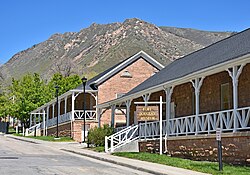
Utah Military Museum (formerly known as Fort Douglas Military Museum), Salt Lake City, Utah.
The Utah Military Museum (formerly the Fort Douglas Military Museum) is operated and managed by the Utah National Guard and serves as its primary repository for historical documents and artifacts. The museum is forecasted to undergo significant renovations and updates in late summer 2026.[4]
12Bennett, Richard Edmond; Black, Susan Easton; Cannon, Donald Q. (2010). The Nauvoo Legion in Illinois: a history of the Mormon militia, 1841-1846. Norman, Okla: Arthur H. Clark Co./University of Oklahoma Press. ISBN978-0-87062-382-0.
↑Prentiss, A (February 24, 1900). The History of the Utah Volunteers in the Spanish American War and in the Philippine Islands. W.F. Ford.{{cite book}}: CS1 maint: date and year (link)
1234567891011121314151617Roberts, Richard (2003). Legacy, the History of the Utah National Guard. National Guard Association of Utah.{{cite book}}: CS1 maint: date and year (link)
This page is based on this Wikipedia article Text is available under the CC BY-SA 4.0 license; additional terms may apply. Images, videos and audio are available under their respective licenses.

 United States
  Utah
Utah  United States Army
  United States Air Force
  National Guard