A landmass, or land mass, is a large region or area of land that is in one piece and not noticeably broken up by oceans. [1] [2] The term is often used to refer to lands surrounded by an ocean or sea, such as a continent or a large island. [3] [4] In the field of geology, a landmass is a defined section of continental crust extending above sea level. [5]
Continents are often thought of as distinct landmasses and may include any islands that are part of the associated continental shelf. When multiple continents form a single contiguous land connection, the connected continents may be viewed as a single landmass. Earth's largest landmasses are (starting with largest): [6] [7] [8]
Generally, the continental landmasses are not all classified as islands despite being completely surrounded by water. [Note 1] However, because the definition of continent varies between geographers, the Americas are sometimes defined as two separate continents while mainland Australia is sometimes defined as an island as well as a continent. [Note 2]
Nevertheless, for the purposes of this list, mainland Australia along with the other three major landmasses have been listed as continental landmasses for comparison. The figures are approximations and are for the four continental landmasses only. [Note 3]
| Rank | Continental landmass [Note 4] | Area | Nation(s) | Notes | |
|---|---|---|---|---|---|
| (km2) | (sq mi) | ||||
| I | Afro-Eurasia (Africa-Eurasia) | 79,810,726 [Note 5] | 30,815,094 | 126 countries | 48 countries and two de facto states on mainland Africa. [Note 6] 78 countries and four de facto states on mainland Eurasia: 1. 38 countries and two de facto states on continental Asia. [Note 7] [Note 8] 2. 40 countries and two de facto states on continental Europe [Note 9] |
| II | America (landmass) | 37,699,623 [Note 10] | 14,555,906 | 22 countries | Ten countries on mainland North America. [Note 11] Twelve countries and an overseas department and region of France on mainland South America. |
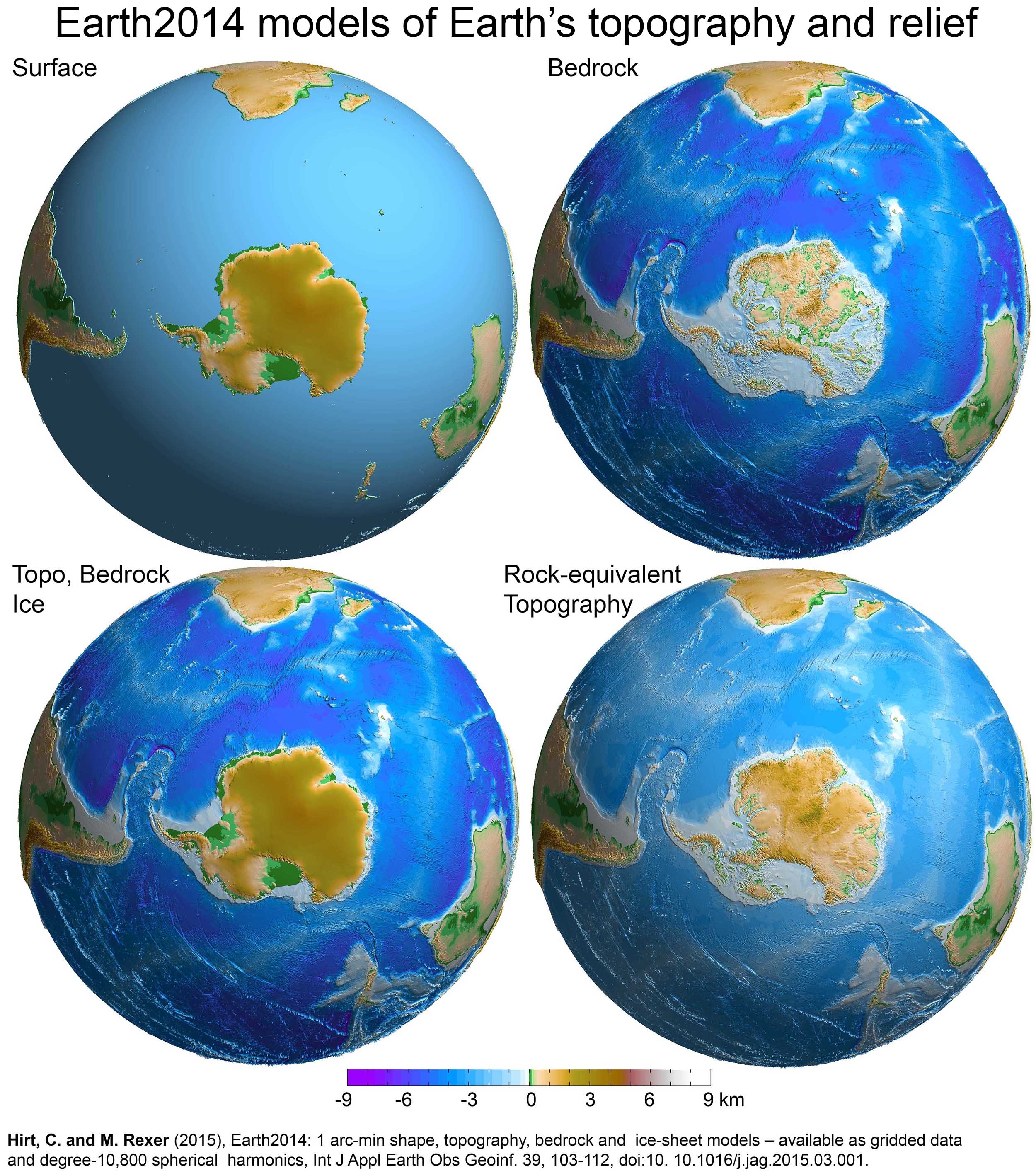
| III | Antarctica | 12,272,800 [Note 12] | 4,738,600 | None [Note 13] | Antarctica is a special case, for if its ice is considered not as land, but as water, it is not a single landmass, but several landmasses of much smaller area, since the ice-bedrock boundary is below sea level in many regions of the continent. [14] If its ice cover were to be lifted, some rocks that are currently below sea level would rise as the weight of the ice would be removed, [15] although this would in part be counteracted, and in some areas of the continent overtaken, by eustatic rises in sea level. [16] |
| IV | Australia (landmass) | 7,591,608 [Note 14] | 2,931,136 | Australia | Mainland Australia is more than three times the size of Greenland, the largest island. [18] Australia is sometimes dubbed "The Island Continent" or "Earth's largest island, but its smallest continent". [19] |
And since Africa and Asia are connected at the Suez Peninsula, Europe, Africa, and Asia are sometimes combined as Afro-Eurasia or Eurafrasia. The International Olympic Committee's official flag, containing [...] the single continent of America (North and South America being connected as the Isthmus of Panama).