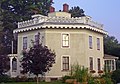
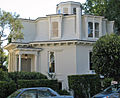
Octagon houses are eight-sided houses that were popular in the United States and Canada mostly in the 1850s. They are characterized by an octagonal (eight-sided) plan and often feature a flat roof and a veranda that encircles the house. Their unusual shape and appearance, quite different from the ornate pitched-roof houses typical of the period, can generally be traced to the influence of amateur architect and lifestyle pundit Orson Squire Fowler. Although there are other octagonal houses worldwide, the term octagon house usually refers to octagonal houses built in North America during this period, and up to the early 20th century.
The leading proponent of octagonal houses was Orson Squire Fowler. Fowler was America's foremost lecturer and writer on phrenology, the pseudoscience of defining an individual's characteristics by the contours of the skull. In the middle of the 19th century, Fowler made his mark on American architecture when he touted the advantages of octagonal homes over rectangular and square structures in his widely publicized book, The Octagon House: A Home For All, or A New, Cheap, Convenient, and Superior Mode of Building, printed in 1848.[1] As a result of this popular and influential publication, a few thousand octagonal houses were erected in the United States, mostly in the Midwest, the East Coast and in nearby parts of Canada.[2]
Design principles
Compared with a square, an octagon encloses approximately 20% additional space with the same perimeter
According to Fowler, an octagon house was cheaper to build, allowed for additional living space, received more natural light, was easier to heat, and remained cooler in the summer. These benefits all derive from the geometry of an octagon: the shape encloses space efficiently, minimizing external surface area and consequently heat loss and gain, building costs, etc. A circle is the most efficient shape but is difficult to build and awkward to furnish, so an octagon is a sensible approximation. Victorian builders were used to building 135° corners, as in the typical bay window, and could easily adapt to an octagonal plan.[citation needed]
Fowler's The Octagon House is sometimes incorrectly referred to as a pattern book, but the popularity of his book lies in the way Fowler suggests some general principles and encourages readers to invent the details for themselves. Only a few examples are offered, and apart from plans, the book has only two illustrations.
Fowler first shows some methods of subdividing an octagonal floor plan. Next is Howland's octagonal plan, a small house designed by Morgan and Brothers architects. There follows A description of the author's own residence, now known as Fowler's Folly, at Fishkill, New York. Finally, A superior plan for a good sized house, which is a development of the Fishkill plans, apparently proposed by his engraver. The main feature of his plans is a desire to eliminate unnecessary circulation space, sometimes to the point that the main staircase is inconvenient, and the external veranda is the best way to get around the house.[citation needed]
Other design proposals include:
a flat roof to collect rainwater, with cisterns built-in to collect and distribute the water.
Rainwater filtering, using filter beds made up of alternating layers of sand and activated charcoal.
Flues, air ducts and speaking tubes built into the thickness of walls.
Masswall construction
Stacked board construction is recommended in the first edition of A Home for All,[3] but the third edition, printed in 1853, has the subtitle: A Home For All, or The Gravel Wall and Octagon Mode of Building, and is distinguished by Fowler's enthusiasm for concrete construction. At the time, concrete construction was not widely used as Portland cement was only recently discovered. Modern concrete is made using Portland cement, not lime, but the main difference is the universal use of steel reinforcing bars, which greatly increase the strength of the material and make it possible to build concrete beams and floor slabs as well as walls.
Fowler knew gravel and lime were available in unlimited quantities in the prairies and advocated the use of "gravel wall" construction for the walls.[4] This was an experimental technique at the time, and although some were built that way, most octagon houses were built the same way as ordinary houses, of timber frame, brick or stone.
To quote Fowler "...those studies which have eventuated in this work were instituted primarily in order to erect this very house".[citation needed] Construction on his house began in 1848, the same year his book was first published, and took five years to complete. The house was large, 42 feet (13m) to each side of the octagon or 100 feet (30m) across, and built on a hilltop overlooking the Hudson River, where it could be seen for miles around. Fowler removed the top of the hill to create a level site and to provide material for his "gravel walls". This grand residence had four huge reception rooms which can be interconnected depending on the size of event, allegedly 60 rooms (counting small dressing rooms as well as proper rooms) and a glass-enclosed cupola rising to 70 feet (21m) above ground. Fowler's favorite writing room was an internal room on the third floor, lit by the cupola via a fanlight over the door. The house had no central staircase, so visitors entered one of the main rooms through a small lobby, while family and staff used the basement entrance. There were verandas all round the house at first-, second- and third-floor levels, linked by two outside stairs.[citation needed]
The house was built using concrete. The walls were built up a few feet at a time, by pouring a mixture of gravel and lime into timber shuttering. As the concrete cured, the shuttering could be taken down and moved up to the next level.[citation needed] Fowler used large stones to reinforce corners, but he used no other reinforcement and was therefore restricted to walls. The roof, floors, and verandas are all of timber construction.[citation needed]
The financial panic of 1857 led Fowler to rent out the house, which subsequently went through a series of owners.[citation needed] Fowler's Folly fell into disrepair, and finally—condemned as a public hazard—it was razed in 1897.[citation needed]
Variations
Within the central idea of the octagonal plan, these houses show a wide variety of both construction and outward form. They range from the modest two-storey Bevis-Tucker House, to the grandiose Armour-Stiner House.[5]
A full octagon house has eight equal sides, although slight variations in length are not unusual. In some cases the basic octagon is partially obscured by additions, either all round as at the Zelotes Holmes House, or by adding a functional wing out of sight at the rear. The House of the Seven Gables in Mayo, Florida, has gables on seven sides while the eighth side is extended to the rear. The Richard Peacon House in Key West, Florida, appears to be a full octagon from the street but the rear portion is squared off.[citation needed]
A moral community headed by Henry S. Clubb tried to establish Octagon City in 1856 in Kansas. It was intended to have an octagonal square with eight roads and octagonal farmhouses and barns. Most settlers had left after the winter.[citation needed]
Gallery
The following are examples of the 'true' octagon houses and the range of design variations to be found.
Rich-Twinn Octagon House in Akron, New York a timber frame house with pitched roof and lantern, veranda all round. Arched windows and window shutters add to the decorative effect.
Octagon House in Barrington, Illinois (built 1860), timber frame house, seen here painted in 'heritage' colors which may reflect the original color scheme.
Feusier Octagon House in San Francisco, California (built 1857), using a masonry ground floor and timber frame second floor, built in a decorative style typical of San Francisco.
Norrish House in Hastings, Minnesota (built 1857-1858), limestone walls finished with cement render, including a veranda all around, flat roof and central lantern.
Worldwide, there are many other octagonal structures that are not associated with Fowler: houses, barns, schoolhouses, churches, and in Canada, octagonal "dead houses". Some early examples include:
This page is based on this Wikipedia article Text is available under the CC BY-SA 4.0 license; additional terms may apply. Images, videos and audio are available under their respective licenses.