Piaggio P.166

Last updated
P.166
Piaggio P166 Albatross ZU-NJZ (Ex SAAF 898) (2) (6925889329).jpg
General information
Type Utility aircraft
National originItaly
Manufacturer Piaggio Aero
Number built~154
History
First flight26 November 1957
Developed from Piaggio P.136

The Piaggio P.166 is an Italian twin-engine pusher-type utility aircraft developed by Piaggio Aero. The aircraft model name was Portofino, and is also known as Albatross in South African military service.

Contents

Design and development

The basic P.166 was a development of the P.136 amphibian and flew for the first time on 26 November 1957. [1] The P.166 had a new fuselage and tail unit but retained the wing and engines from the P.136. Several were purchased for use as executive transports or as feeder and taxi aircraft. The improved P.166B was more powerful and had up to ten seats; a prototype was first flown on 27 March 1962.

A further version, the 12-seater P.166C with improved undercarriage, first flew on 2 October 1964.

A turboprop-powered variant, the P.166D, was developed with Lycoming LTP101 engines and it first flew on 3 July 1976.

Variants

P.166
Prototypes powered by 340 hp (254 kW) Lycoming GSO-480-B1C6 engines, three built. [2]
P.166AL1
First production version with non-slanted cockpit side windows. Accommodation for two pilots and six–eight passengers. Powered by 340 hp (250 kW) Lycoming GSO-480-B1C6 engines, [3] 29 built. [2]
P.166B Portofino
Revised, more powerful version with longer nose. Powered by two 380 hp (283 kW) Lycoming IGSO-540-A1C engines. [4] Five built. [5]
P.166BL2/APH
Photo survey aircraft for Italian Air Force. Two built. [6]
ZS-MMI, an ex-South African Air Force P.166S Albatross SAAF Piaggio P166 01.jpg
ZS-MMI, an ex-South African Air Force P.166S Albatross
P.166CL2
Feederliner version of P.166B with external landing gear pods to allow a revised cabin giving room for up to 12 passengers. [7] Two built. [5] or another source gives four built [2]
P.166DL3
Light utility transport version, powered by two 450 kW (600 hp) Lycoming LTP101-600 turboprop engines. [8] 14 built including sub-variants. [2]
P.166DL3/APH
Photo survey aircraft version of -DL3. Six built for Italian Air Force. [9]
P.166DL3/MAR
Maritime patrol version of DL3. Two built for Somalia. [10]
P.166DL3/SEM
Paramilitary maritime patrol (SEM - Sorveglianza Ecologia e Marittima - Maritime and ecological surveillance) version of DL3. 12 aircraft built for Italian Coast Guard and ten for Guardia di Finanza . [11]
P.166DP1
Re-engined version with 615 shp (459 kW) Pratt & Whitney PT6A-121 turboprops. Eight converted (two from -DL3 and six from -DL3/SEM) for Guardia di Finanza. [12]
P.166M
Military version of P.166A, 49 built for Italian air force. [6]
P.166S Albatross
Coastal patrol, search and rescue version of the South African Air Force with longer P.166B-type nose and larger tip tanks, 20 built. [10]

Operators

Flag of Australia (converted).svg  Australia [13] [14]
Italian Guardia Costiera Piaggio P-166DL3-SEM, Italy - Coast Guard JP6366883.jpg
Italian Guardia Costiera
United Nations Humanitarian Air Service Piaggio P-166DL-3APH, Italy - Air Force JP6734983.jpg
United Nations Humanitarian Air Service
Flag of Italy.svg  Italy
Flag of Somalia.svg  Somalia
Flag of South Africa (1928-1982).svg  South Africa

Notable accidents and incidents

Specifications (P.166-DL3)

Flight deck Piaggio P-166DL3-SEM, Italy - Guardia di Finanza JP7365578.jpg
Flight deck

Data fromJane's all the World's Aircraft 1988–89 [18]

General characteristics

14.69 m (48 ft 2.5 in) with tip-tanks

Performance

139 km/h (86 mph; 75 kn) flaps down, gear down
2,084 km (1,295 mi; 1,125 nmi) with max standard fuel (wing and tip tanks)
4,270 m (14,000 ft) on one engine
3 m/s (580 ft/min) on one engine

See also

Related development

Related Research Articles

<span class="mw-page-title-main">Piper PA-24 Comanche</span> American four- or six-seat monoplane built 1956–1972

The Piper PA-24 Comanche is an American single-engine, low-wing, all-metal monoplane of semimonocoque construction with tricycle retractable landing gear and four or six seats. The Comanche was designed and built by Piper Aircraft and first flew on May 24, 1956. Together with the PA-30 and PA-39 Twin Comanches, it made up the core of Piper's lineup until 1972, when the production lines for both aircraft were destroyed in the 1972 Lock Haven flood.

<span class="mw-page-title-main">Piper PA-25 Pawnee</span> American agricultural aircraft

The PA-25 Pawnee is an agricultural aircraft produced by Piper Aircraft between 1959 and 1981. It remains a widely used aircraft in agricultural spraying and is also used as a tow plane, or tug, for launching gliders or for towing banners. In 1988, the design rights and support responsibility were sold to Latino Americana de Aviación of Argentina.

<span class="mw-page-title-main">Piaggio PD.808</span> Business jet aircraft

The Piaggio PD.808 was an Italian business jet built by Piaggio. It was designed as a joint venture between Piaggio and Douglas Aircraft Company of Long Beach, California, United States.

<span class="mw-page-title-main">Piper PA-48 Enforcer</span> American turboprop-powered light close air support aircraft

The Piper PA-48 Enforcer is an American turboprop-powered light close air support aircraft built by Piper in the 1970s. It is a development of the World War II-era North American P-51 Mustang fighter. The Enforcer concept was originally created and flown as the Cavalier Mustang by David Lindsay, owner of Cavalier Aircraft, in response to the United States Air Force PAVE COIN program, but Cavalier did not have the manufacturing abilities to mass-produce the Enforcer, so the program was sold to Piper by Lindsay in 1970.

<span class="mw-page-title-main">Cessna 421 Golden Eagle</span> Pressurized twin-engine general aviation aircraft

The Cessna 421 Golden Eagle is an American six or seven seat twin-engined light transport aircraft, developed in the 1960s by Cessna as a pressurized version of the earlier Cessna 411.

<span class="mw-page-title-main">Zlín Z 43</span> 1968 Czech four-seat light aircraft

The Zlín Z 43 is a Czech four-seat light aircraft. A development of the two-seat Zlín Z 42, it is a low-wing monoplane. A developed version, the Zlín Z 143 remains in production.

<span class="mw-page-title-main">Grob G 120</span> German light aircraft

The Grob G 120 is a two-seat training and aerobatic low-wing aircraft with a carbon composite airframe, built by Grob Aircraft. It is based on the Grob G 115TA training aircraft and is specially designed for military and civil pilots training. It has a tricycle landing gear and a low tailplane.

<span class="mw-page-title-main">Partenavia Oscar</span>

The Partenavia P.64B/P.66B Oscar is an Italian two/four-seat, single-engined, high-wing monoplane built by Partenavia.
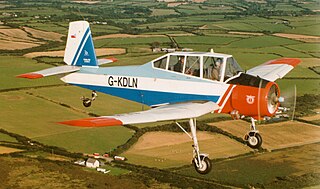
<span class="mw-page-title-main">Zlin Z-37 Čmelák</span> Czechoslovak agricultural aircraft

The Zlin Z-37 Čmelák, also known as LET Z-37 Čmelák is an agricultural aircraft which was manufactured in Czechoslovakia. It is powered by a Soviet-built Ivchenko reciprocating engine. The aircraft is used mainly as a cropduster.

<span class="mw-page-title-main">Piper PA-36 Pawnee Brave</span>

The Piper PA-36 Pawnee Brave is a 1970s American single-engined, low-wing, propeller-driven agricultural plane built by Piper Aircraft.

The Boisavia B.260 Anjou was a four-seat twin-engine light aircraft developed in France in the 1950s. It was a low-wing cantilever monoplane of conventional configuration with retractable tricycle undercarriage. Intended by Boisavia as a touring aircraft, it did not find a market and only the single prototype was constructed. At this point, the firm sold the design to SIPA, which modified the design and re-engined it with Lycoming O-360 engines, but found that they could not sell it either. At a time when the twin-engine light plane market was already dominated by all-metal American aircraft, the Anjou's fabric-over-tube construction was something of an anachronism, and all development was soon ceased. Plans to develop a stretched version with three extra seats and Potez 4D engines were also abandoned.
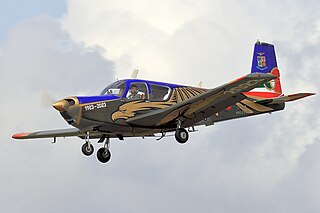
<span class="mw-page-title-main">SIAI-Marchetti S.205</span>

The SIAI-Marchetti S.205 is an Italian four-seat, single-engine, light airplane, manufactured by SIAI-Marchetti. The S.205 made its maiden flight in 1965. The Italian Air Force employs a version called S.208.
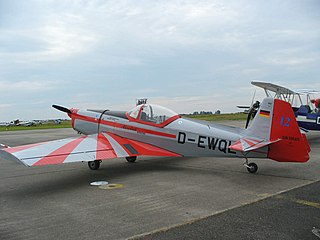
<span class="mw-page-title-main">Zlín Z 526</span>

The Zlin Z-526 Akrobat is a Czech sports plane used in aerobatics.

<span class="mw-page-title-main">Piaggio P.136</span> Amphibious flying boat

The Piaggio P.136 is an Italian twin-engine amphibian flying boat designed and manufactured by aircraft company Piaggio Aero. It is furnished with an all-metal hull, pusher propellers, a gull wing, and retractable landing gear.

<span class="mw-page-title-main">FFA AS 202 Bravo</span> Type of aircraft

The AS/SA 202 Bravo is a two to three-seat civil light aircraft jointly designed and manufactured by the Swiss company Flug- und Fahrzeugwerke Altenrhein (FFA) and the Italian company Savoia-Marchetti. The aircraft was designated the AS 202 in Switzerland, and the SA 202 in Italy.

<span class="mw-page-title-main">Piaggio P.148</span> Type of aircraft

The Piaggio P.148 was a 1950s Italian two-seat primary or aerobatic training monoplane designed and built by Piaggio Aero.
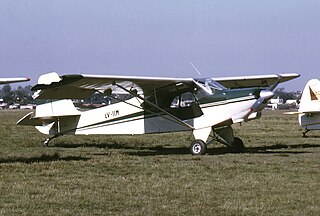
<span class="mw-page-title-main">DINFIA IA 46</span> 1950s Argentinian light aircraft

The DINFIA IA 46 Ranquel, IA 46 Super Ranquel, and IA 51 Tehuelche were Argentine utility aircraft developed in the late 1950s.

<span class="mw-page-title-main">Italair Pegaso</span> Type of aircraft

The Italair F.20 Pegaso was a twin-engine utility aircraft designed by Stelio Frati and built in Italy in 1971.

<span class="mw-page-title-main">IAR-827</span> Type of aircraft

The IAR-827 was an agricultural aircraft built in Romania in the 1970s and 1980s. The penultimate member of the family of designs that began with the IAR-821, it was, like the others, a conventional low-wing monoplane with fixed, tailwheel undercarriage, and shared the all-metal construction of the IAR-826. The prototype flew in 1976, powered by a Lycoming IO-720 engine, but the production examples that followed all had the PZL-3S.

<span class="mw-page-title-main">Taylorcraft F-21</span> Type of aircraft

The Taylorcraft F-21 is a high-wing American-built certified light aircraft developed from earlier Taylorcraft designs.

References

  1. Taylor 1961, p. 105.
  2. 1 2 3 4 Simpson 1991, pp.232-233
  3. Taylor 1961, p. 106.
  4. Taylor 1965, p. 97.
  5. 1 2 Taylor 1976, p. 114.
  6. 1 2 3 Nicolli 2012, p. 88.
  7. Stroud 1994, p. 66.
  8. 1 2 Nicolli 2012, p. 89.
  9. 1 2 Nicolli 2012, pp. 88–90.
  10. 1 2 Nicolli 2012, pp. 88–89.
  11. 1 2 3 Nicolli 2012, p. 90.
  12. 1 2 Nicolli 2012, pp. 90–91.
  13. "VH-MMP Piaggio P.166". Air History. Retrieved 2 July 2021.
  14. "Piaggio P.166". Air History. Retrieved 25 July 2021.
  15. Nicolli 2012, pp. 87–88.
  16. 1 2 Marcellino 2018, p. 88.
  17. "All 13 people dead in crashed planes".
  18. Taylor, John W.R., ed. (1988). Jane's all the World's Aircraft 1988–89 (79th ed.). London: Jane's Information Group. p. 165. ISBN   0-7106-0867-5.
  19. Lednicer, David. "The Incomplete Guide to Airfoil Usage". m-selig.ae.illinois.edu. Retrieved 16 April 2019.