Transatlantic relations

Last updated
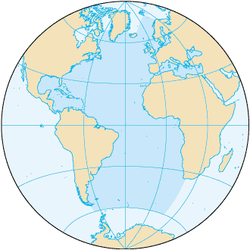
Atlantic Ocean Atlantic Ocean.png
Atlantic Ocean

Transatlantic relations refer to the historic, cultural, political, economic and social relations between countries on both side of the Atlantic Ocean. Sometimes it specifically means relationships between the Anglophone North American countries (the United States and Canada), and particular European countries or organizations, although other meanings are possible.

Contents

There are a number of issues over which the United States and Europe generally disagree. Some of these are cultural, such as the U.S. use of the death penalty, some are international issues such as the Middle East peace process where the United States is often seen as pro-Israel and where Europe is often seen as pro-Arab (or at least neutral), and many others are trade related. The current U.S. policies are often described as being unilateral in nature, whereas the European Union and Canada are often said to take a more multilateral approach, relying more on the United Nations and other international institutions to help solve issues. There are many other issues upon which they agree. [1]

Definition

One potential definition of transatlantic relations. The United States (in red), Canada (in green), the European Union and United Kingdom (in blue). Excluded from this definition are non-EU states in Europe other than the United Kingdom, and all of Latin America and Africa. Us canada eu 2007.png
One potential definition of transatlantic relations. The United States (in red), Canada (in green), the European Union and United Kingdom (in blue). Excluded from this definition are non-EU states in Europe other than the United Kingdom, and all of Latin America and Africa.
It is proposed to create a Transatlantic Free Trade Area between the United States and European Union. Map shows potential other members: NAFTA, EFTA and future EU members. TAFTA.png
It is proposed to create a Transatlantic Free Trade Area between the United States and European Union. Map shows potential other members: NAFTA, EFTA and future EU members.

Transatlantic relations can refer to relations between individual states or to relations between groups of states or international organizations with other groups or with states, or within one group. For example:
Within a group:

e.g. Canada–NATO relations

Between groups:

Between a group and a state:

Between states:

By language and culture

The boundaries of which states are part of Transatlantic relations depends on the context. The term may be used as a euphemism to a specific bilateral relationship, for example, Anglo-American relations. The boundary could be drawn so as only to refer member states of the EU plus the US, when discussing Euro-American relations. In other circumstances it may include Canada, or non-EU countries in Europe. The term may also be used in the context of the wider Atlantic world including Africa and Latin America.

History

The triangular trade in the North Atlantic Triangle trade2.png
The triangular trade in the North Atlantic

The early relationship between Europe and America was based on colonialism and mercantilism. The majority of modern states in the Americas can be traced back to colonial states that were founded by European nations, states that were very different from the pre-Columbian civilizations and cultures that had existed before.

Even after the United States (and later Canada) became independent, the main relationship between the two continents was one-way migration.

Politically the United States tried to keep a distance from European affairs, and Canada was subordinate to British foreign policy.

During the First World War however both North American states found themselves fighting in Europe and engrossed in European politics. President Woodrow Wilson's Fourteen Points helped to redraw the map of Europe.

Although the Roosevelt administration wanted to enter the war against Germany, the vast majority of Americans were too isolationist and disillusioned at their experience in World War I to seek involvement in the World War II, at least until the U.S. was attacked by Japan at Pearl Harbor on December 7, 1941, and Adolf Hitler declared war on the United States on December 11, 1941. Once involved, the US became pivotal to the war effort and therefore European politics.

After the second war the United States and Canada both desired a permanent role in the defence of Europe, and European states wanted protection from the Soviet Union. The result was the North Atlantic Treaty Organization, which became the lynchpin of Transatlantic relations during the Cold War. [1]

Atlanticism is a philosophy which advocates for close cooperation between North America and Europe.

  Non-European countries
  Transcontinental countries
Comparison of the two main Euro-Atlantic defence organisations
 Flag of Europe.svg European Union
(in respect of its defence arm, the Common Security and Defence Policy)
Flag of NATO.svg NATO
Mutual defence clause Article 42.7 of the consolidated version of the Treaty on European Union:

"If a Member State is the victim of armed aggression on its territory, the other Member States shall have towards it an obligation of aid and assistance by all the means in their power, in accordance with Article 51 of the United Nations Charter. This shall not prejudice the specific character of the security and defence policy of certain Member States. [...]"

Article 5 of the North Atlantic Treaty:

"The Parties agree that an armed attack against one or more of them [on their territory] shall be considered an attack against them all and consequently they agree that, if such an armed attack occurs, each of them, in exercise of the right of individual or collective self-defence recognised by Article 51 of the Charter of the United Nations, will assist the Party or Parties so attacked by taking forthwith, individually and in concert with the other Parties, such action as it deems necessary, including the use of armed force, to restore and maintain the security of the North Atlantic area. [...]"

 Political strategic organisation
Highest office High Representative (HR/VP) Secretary General
Principal decision-making body Foreign Affairs Council North Atlantic Council
Liaison body European External Action Service International Staff
Seat Kortenberg building (Brussels, Belgium) Coat of arms of the NATO Headquarters.png NATO headquarters (Brussels, Belgium)
 Military strategic organisation
Supreme commander Coat of arms of the European Union Military Staff.svg Golden star.svg Golden star.svg Golden star.svg Director of the Military Planning and Conduct Capability Coat of arms of Supreme Headquarters Allied Powers Europe.svg Golden star.svg Golden star.svg Golden star.svg Golden star.svg Supreme Allied Commander Europe
Headquarters Coat of arms of the European Union Military Staff.svg Military Planning and Conduct Capability (Brussels, Belgium) Coat of arms of Supreme Headquarters Allied Powers Europe.svg Supreme Headquarters Allied Powers Europe (Mons, Belgium)
Chair of chiefs of defence assembly Coat of arms of Europe.svg Golden star.svg Golden star.svg Golden star.svg Golden star.svg Chairman of the European Union Military Committee Coat of arms of the Chairman of the NATO Military Committee.svg Golden star.svg Golden star.svg Golden star.svg Golden star.svg Chair of the NATO Military Committee
Chiefs of defence assembly Coat of arms of the European Union Military Committee.svg European Union Military Committee Coat of arms of the Chairman of the NATO Military Committee.svg NATO Military Committee
Advisory body Coat of arms of the European Union Military Staff.svg European Union Military Staff Coat of arms of the International Military Staff.svg International Military Staff
  EU Membership Permanent Structured Cooperation NATO Membership
Member states of both the EU and NATO
Flag of Belgium (civil).svg Belgium FounderFounderFounder
Flag of Bulgaria.svg Bulgaria 2007Founder2004
Flag of Croatia.svg Croatia 2013Founder2009
Flag of the Czech Republic.svg Czech Republic 2004Founder1999
Flag of Denmark.svg Denmark 19732023Founder
Flag of Estonia.svg Estonia 2004Founder2004
Flag of Finland.svg Finland 1995Founder2023
Flag of France.svg France FounderFounderFounder
Flag of Germany.svg Germany FounderFounder1955
Flag of Greece.svg Greece 1981Founder1952
Flag of Hungary.svg Hungary 2004Founder1999
Flag of Italy.svg Italy FounderFounderFounder
Flag of Latvia.svg Latvia 2004Founder2004
Flag of Lithuania.svg Lithuania 2004Founder2004
Flag of Luxembourg.svg Luxembourg FounderFounderFounder
Flag of the Netherlands.svg Netherlands FounderFounderFounder
Flag of Poland.svg Poland 2004Founder1999
Flag of Portugal (official).svg Portugal 1986FounderFounder
Flag of Romania.svg Romania 2007Founder2004
Flag of Slovakia.svg Slovakia 2004Founder2004
Flag of Slovenia.svg Slovenia 2004Founder2004
Flag of Spain.svg Spain 1986Founder1982
Flag of Sweden.svg Sweden 1995Founder2024
Non-NATO EU member states
Flag of Austria.svg Austria 1995Founder Partnership for Peace
Flag of Cyprus.svg Cyprus  2004Founder No
Flag of Ireland.svg Ireland 1973Founder Partnership for Peace
Flag of Malta.svg Malta 2004No Partnership for Peace
Non-EU NATO member states
Flag of Albania.svg Albania Candidate N/a2009
Flag of Iceland.svg Iceland NoN/aFounder
Flag of Montenegro.svg Montenegro Candidate N/a2017
Flag of North Macedonia.svg North Macedonia Candidate N/a2020
Flag of Norway.svg Norway Defence Agency agreement N/aFounder
Flag of Turkey.svg Turkey   Candidate N/a1952
Flag of the United Kingdom.svg United Kingdom NoN/aFounder
European countries outside both the EU and NATO
Flag of Andorra.svg Andorra  NoN/aNo
Flag of Armenia.svg Armenia  NoN/a Individual Partnership Action Plan
Flag of Azerbaijan.svg Azerbaijan  NoN/a Individual Partnership Action Plan
Flag of Belarus.svg Belarus NoN/a Partnership for Peace
Flag of Bosnia and Herzegovina.svg Bosnia and Herzegovina Candidate N/a Membership Action Plan
Flag of Georgia.svg Georgia   Candidate N/a Intensified Dialogue
Flag of Kazakhstan.svg Kazakhstan  NoN/a Individual Partnership Action Plan
Flag of Kosovo.svg Kosovo Applicant / Potential candidate N/aNo
Flag of Liechtenstein.svg Liechtenstein  NoN/aNo
Flag of Moldova.svg Moldova Candidate N/a Individual Partnership Action Plan
Flag of Monaco.svg Monaco  NoN/aNo
Flag of Russia.svg Russia  NoN/a Partnership for Peace
Flag of San Marino.svg San Marino  NoN/aNo
Flag of Serbia.svg Serbia Candidate N/a Individual Partnership Action Plan
Flag of Switzerland (Pantone).svg  Switzerland Defence Agency agreement N/a Partnership for Peace
Flag of Ukraine.svg Ukraine Candidate N/a Intensified Dialogue
Flag of Vatican City (2023-present).svg Vatican City  NoN/aNo
NATO member states located in North America, which are therefore ineligible for EU membership
Flag of Canada (Pantone).svg Canada N/aN/aFounder
Flag of the United States.svg United States N/aN/aFounder
Members of NATO's Partnership for Peace located outside Europe, which are therefore neither eligible for EU nor NATO membership
Flag of Kyrgyzstan.svg Kyrgyzstan N/aN/a Partnership for Peace
Flag of Tajikistan.svg Tajikistan N/aN/a Partnership for Peace
Flag of Turkmenistan.svg Turkmenistan N/aN/a Partnership for Peace
Flag of Uzbekistan.svg Uzbekistan N/aN/a Partnership for Peace

See also

References

  1. 1 2 Portero, Florentino (May 29, 2002). "Las relaciones transatlánticas" (in Spanish). Madrid: Elcano Royal Institute . Retrieved April 11, 2021.
  2. EFTA Archived 2008-04-22 at the Wayback Machine
  3. "Foreign Affairs Department, Canada". Archived from the original on 2011-05-20. Retrieved 2008-03-20.

Bibliography